A footwear minefield

Plenty of runners will tell you that there’s nothing quite like unboxing a new pair of trainers. That first glimpse of a pristine, never-before-worn pair of kicks that will, of course, elevate your running from slow plodder, to blazing speed-merchant.

Sadly, the new trainer high only lasts a mere moment. If you talk to a trail runner – minutes. Mud covered and bashed up tends to be the norm, but there’s a whole other world of trainer politics to be discussed if you scratch beneath the surface. Should we keep buying new shoes? What happens to the old ones? Do I need better grip? Should I be running barefoot the whole time?
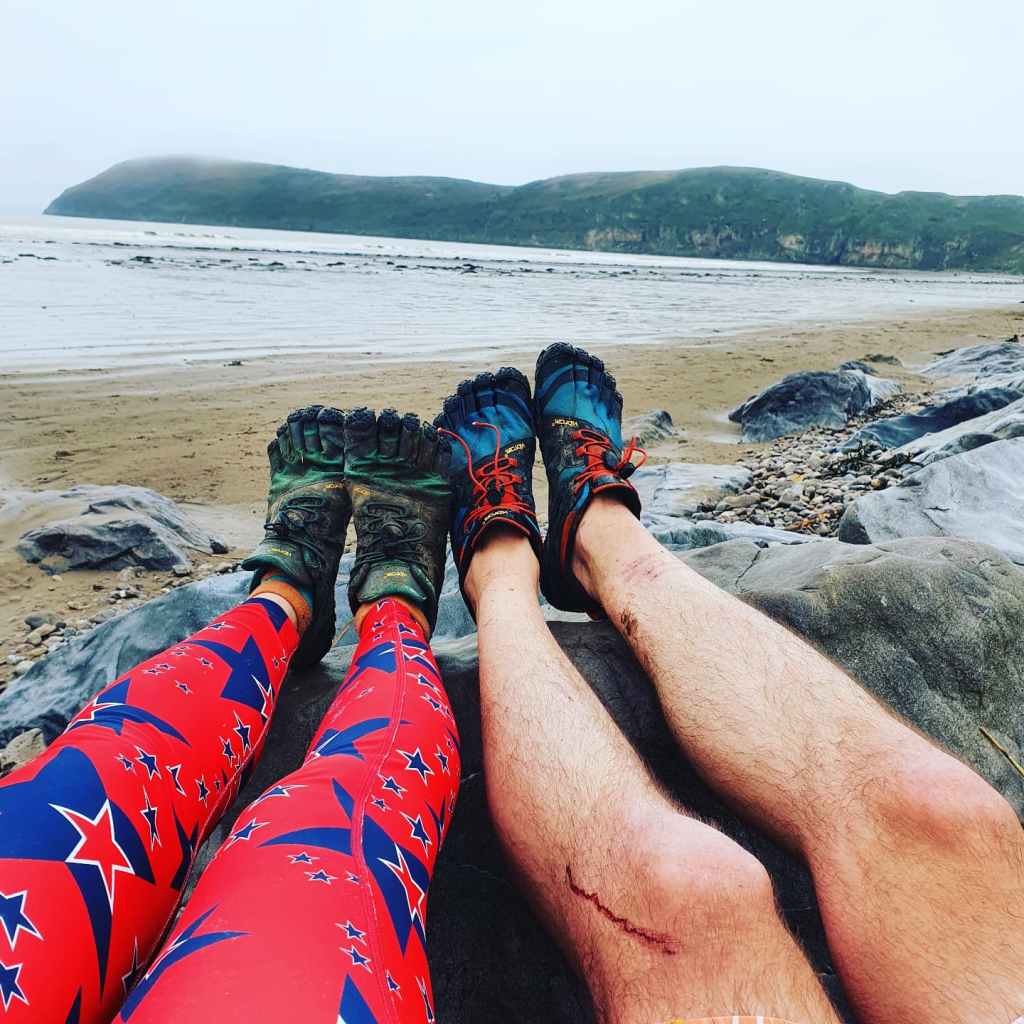
Vibram Fivefingers V-Trail shoes are my go-to shoe

Plenty of you will know that I run in barefoot shoes – my go-to shoe is the Vibram V-Trail. I landed on this footwear after dabbling with a Merrell Vapor Glove, but before that I’d spent years forcing my toes into more conventional narrow trainers. Inevitably, the squishing of the toes caused foot pain and/or blisters, but it took me years to learn that I could make huge improvements in my foot health just my rethinking my running shoes.

A couple of years of running in barefoot shoes means it’s become “the norm” for me. But training for The Dragon’s Back Race has forced my hand (well, foot), into rethinking what to wear on the mountains.

Initially I sent out a message on social media asking for recommendations on footwear for the mountains, and let me tell you, the barefoot crowd were vocal! I’ve learnt over the years that my feet are only stronger from running barefoot. I appear to have fewer foot issues overall using barefoot shoes, and it’s given me a better understanding of my biomechanics.

Despite all the good things that barefoot running has to offer us, there are still in my opinion, times when we need something a bit more robust. Ourea, the organisers of DBR strongly recommend against barefoot shoes. I had started to feel guilty for considering other trainers, but nonetheless I capitulated and forked out on a pair of Altra Lone Peaks – a zero drop shoe with a wide toe box. It offered the grip that I was searching for – so I thought.

However good the Altra was on a gritty trail or a rocky climb, every time I hit wet grass, I hit the deck. After a 12 mile trail run involving five falls, I felt was back to square one.

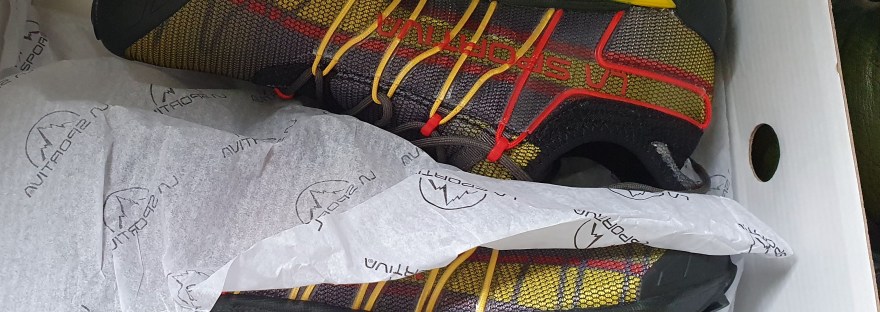
So I did some more research and was recommended the La Sportiva Mutant – a shoe that is more focussed on mountains. It’s 10mm drop is a far cry from my zero drops, but I’ve given it a couple of tries now. The initial tightness around the mid-foot is giving a little. The grip is far superior to other trainers I’ve tried – but the real test will be to see how my feet fare over real long distances in them.

La Sportiva Mutants newly unboxed and ready for some mountain running

I’m really frugal about buying kit generally, and when I buy new trainers I feel like it’s at odds with my environmental/sustainable ethos. I’d much rather wear a pair to death/try to fix them/pass them on, so new shoes feel like a real luxury and I’m mindful that I have to look after them and get the most out of them.

I talk to loads of runners who are really brand loyal when it comes to their choice of running shoe. Admittedly, if you find a shoe that doesn’t give you any problems, then why would you change. But I’ve had to open up my mind to new shoe horizons.

The impact that discarded trainers is having on the planet is terrifying. And let’s face it, it all ends up in landfill so the choice to buy new shoes is one that needs careful consideration. This is something that doesn’t pass me by.

I’m not leaving behind my barefoot days. Far from it. All my non-mountain training will be done in barefoot shoes, while the new La Sportivas will be broken in on mountains and hills only. I wear barefoot shoes in day to day life, so my feet won’t forget how to be feet either!

What happens to the old shoes? Well, there are plenty of schemes where you can donate old trainers – Jog On is a scheme that’s partnered up with sportsshoes.com to keep millions of shoes out of landfill. Brands such as Vivobarefoot, Schuh and Nike offer recycling schemes, or you could take your shoes to a clothing bank to see them reused for good.

Still got the Merrell Vapor Glove

Don’t just throw them out when you’re done with them. Pass them on. I feel very fortunate that I have the opportunity to open a pair of shiny new trainers, but I’m remaining steadfast about getting every last mile out of the ones I already own.

What’s right for one runner doesn’t make it right for the next person. I can’t tell you what shoe is right for you. Barefoot running is also a bit like Marmite, but whatever your preference, for barefoot, or cushioned, zero drop, or latest release, we all do need to make more considered choices about the impact of our gear on the planet.

Failing as part of the process

Learning when to stop has been an important lesson for me as I strive to slay the Dragon

You know the person that always says hi, is permanently perky, doesn’t shut up giving positive affirmations and constantly tries to cheer other people up? Well that’s me. Mostly.

Being an eternal optimist has always stood me in good stead. I don’t stress about much, I “grab life by the balls”, and all that stuff. But recently, a swathe of pessimism and bad luck started to chip away at that perky exterior.

Training has certainly suffered as a result of a lack of time, but more worryingly, due to a lack of enthusiasm. It’s been totally out of character. The cherry on top of the Cake of Gloom was a proper belter of a head cold/virus, that struck before the weekend recce that would see me attempt 17 miles from Conwy Castle (start of the Dragon’s Back Race), to the Ogwen Valley support point.

As a merry band of Dragons gathered at the meeting point, I knew that although I wasn’t feeling my best – a lack of sleep, a total shocker of a journey up the night before, and a trepidation that I think everyone experiences before these events, I would nonetheless give it my best.

Early on, as the other Dragons skipped their way up the hills – I knew I was far from skipping – more trudging. Reluctantly, begrudgingly. My legs didn’t want to cooperate and my head – well it felt like it might just explode.

I didn’t want to talk. When the lovely team members asked questions and started chattering, I was one-line answers at best. What the hell was going on? One guy even ran back to check in on me. “I’ve been there”, he said. “It chips away at you mentally.” Boy, was he right. Being back of the pack when you’re working at capacity can feel like a grenade to the brain.

RAW Adventures Event leader Kate knew something was up. She’d seen me running in February and knew that things were amiss. Where was the perky Laura she’d met two months ago? She asked gently, maybe we should think about splitting the group?

I didn’t need much convincing. The pace I was running meant at least another seven hours on the mountain. I didn’t want to hold the others back, and I certainly didn’t want to feel like this for another seven hours.

Save your legs, Kate said, Make the next day count.

We turned back at seven miles – after summitting Tal y Fan, and took a gentler slope back down into Conwy. I’d managed 12 slow miles.

I’d cried. I doubted if this was even achievable. This race is not for the feint hearted. Here I was failing on a recce – what the hell chance did I have on race week?

But here’s the thing. We don’t win all the time. In fact every step of the journey is beset by stumbling blocks – mentally and physically. Sure, I could have run the 17 miles but in doing so, what would the rest of that week’s training look like?

At least my legs were fresh enough to summit Pen Yr Ole Wen the following day – just shy of 1,000 metres. By myself, in the mist.

This is a lesson. A powerful one. That no, sometimes Laura you can’t just steamroller through something and hope you’ll wing it with a smile. That a cold, a virus, a blow to your immune system, really will take it out of you, and you can’t just brush that off.

That it’s OKAY to take a few days to eat, drink, rest, recuperate, and come back to a stronger mindset and feel like you can see a way through.

I couldn’t write this blog post for a while. What was the point, I thought? It’s not even like I can run well at the moment. Who even wants to read this? But I think it’s important that I document the low parts, because everyone deserves to know that failure is crucial. It’s the getting back up that makes us stronger…… and see, even the positive mantras are starting to come back to me again!

By the way. Kate, you’re amazing. I think everyone needs a Kate in their lives.

The importance of cheerleaders

Self-motivation is a powerful tool, but there are times when you need people in your corner to give you the push you need.

I’ve been having a hard time seeing the wood for the trees these past few weeks. I’ve been cautiously monitoring a niggle in my back, and there have been situations in life that have left me feeling fairly bleak in terms of motivation.

I’ve been eating not great food; sitting around at work a lot; feeling sorry for myself over the lack of sunshine (but seriously, spring, it really is time for you to turn up now); and there has been a serious lack of good news in my family and friends circle.

The back niggle had been playing on my mind. Was it something serious? I have another mountain recce event coming up and I was worried it would put the stoppers on that. Then I’ve been thinking, it’s practically April and I don’t feel my training is where I want or need it to be.

The boosty people around us are great motivation for getting us out there

But, I have been consistent. Even with the muscle injury, I’ve been managing to run treadmill style (still hate it), as forward/backward motion isn’t affected, as well as stretching and strength work. This has, I hope, kept my fitness at a decent level for now.

Lateral movement has been at times excruciating. Could have come from hill work, could have come from spinning around on a hoop, but ultimately, it’s been put down to overcompensating for a mega-tight right-hand-side. Who knew! Long story very short, I visited my insanely good sports therapist the one and only Debbie Domoney, who assured me that movement is medicine.

She always encourages my nuts adventures, my aerial antics, and she knows how anxious I can get if I’m told not to do activity. She basically fixed me. loosening the right back, working the erector spinea (postural muscles), using rock pods – weird little suction cup things, and strapping me up.

My personal trainer Ali has also worked so hard to facilitate my crook back, and I’ve not missed out on any strength training as a result.

Then there’s my hoop partner Lexi who just so happens to be a physio – and very much a positive and encouraging role model. If it doesn’t hurt too much, let’s try it!

Then there are the friends for whom a phone call to give you a boost is really all you need. They’re the ones who lift you when you feel really low and life is going in the right direction. I’m lucky to have a few of these. They make all the difference.

I’ve gone through the blip, and I’m hopefully emerging from the other side with a better back and a thirst to get back on the horse (or in this case the Dragon!)

So moving forward, very literally, I’ll be incorporating more lateral stretching into my week, upping the elevation and interval sessions, oh, and regularly checking in with the people that I call my cheerleaders.

Here’s to spring, healthy eating, and getting on top of training!

Incredible women who run

Running heroes doing the sport justice

Off the back International Women’s Day I feel it’s important to celebrate women and the great stuff they do all year round.

I mean, I’m a mum all the time, so where Mother’s Day is just a tokenism – I hope that I’m appreciated the rest of the time too! International Women’s Day is a brilliant concept, but let’s not forget women for the rest of the year.

I’ve been thinking about women in sport, and in particular, trail and ultra running. Training for the Dragon’s Back Race and working it around mum life, day to day work and taxi-ing, I’m thinking about the barriers that affect my journey getting to the start line, and I’ve been talking to other women and finding out what their challenges are. There’s a bigger piece in the pipeline about women’s barriers to ultra running, but for now I wanted to focus on those runners that I hold in high regard for speaking out, making change, holding true to their beliefs and leading to positive changes in the sport.

There is no particular order to this list, and there are so, so many more than this, but here are some women that have made me sit up and think, and feel more empowered to continue with what I believe too. I hope they can inspire you too.

Sophie Power

A photograph of Sophie breastfeeding her three-month old during a 106-mile ultra went viral – it’s now featured in the Guardian’s 50 Photographs that Reshaped Sport, and off the back of the photograph she used the publicity to launch the SheRaces Campaign, fighting for equal opportunities in racing, and working with event organisers to make their events more inclusive.

Pregnancy deferral policies and race guidelines that consider female participation have all been taken up by various events thanks to Sophie’s work. Not only is her breastfeeding image iconic, she’s also a phenomenal runner.

Find out more about Sophie on her website and at SheRaces

Sabrina Pace-Humphreys

I interviewed Sabrina for a piece about trail running vs road running, and her passion for trail running was just so contagious (despite me loving it already!) Sabrina is a co-founder of Black Trail Runners, and as a mum of four, and having faced so many challenges before finally tying up her shoelaces and setting up an all-female running group, she’s a mental health advocate and an inspiration for women runners from all backgrounds.

Read more about Sabrina on her website

Fiona Oakes

Fiona is an elite ultra runner and the fastest woman in the world to run a marathon on all seven continents and the north pole in both cumulative and elapsed time. Not only that, she’s had 17 surgeries on her right knee which saw her kneecap being completely removed, she runs a sanctuary which looks after more than 600 animals, she’s competed in more than 100 marathons, placing top twenty in Berlin and London marathons and she’s a vegan! What a flipping amazing human being!

Find out more about her and her running on the Fiona Oakes Foundation website

Vic Izzy Owens

Vic (above) is one of three women on this list who I’ve had the pleasure of meeting in person – I first met Vic, aka The Happy Runner, when she and I were involved in The National Running Show Indoor Relay. It blew my mind that someone could run around and around her back garden completely barefoot for marathon miles, and then she went on to became the fastest person and only woman to run The Monarch’s Way. She inspired me to try barefoot running, but more than that I think she actually showed me that it’s ok to run the way you choose and not be constrained by societal norms. She’s a wonderful human and now runs We Run Bright, a running clothing brand together with her friend and fellow runner Gavin King.

Follow Vic on Instagram at @thehappyrunnernw

Nikki Love

Nikki is an advocate for anyone who wants to do it their way. An author, speaker and runner, Nikki’s tagline is “Chasing Extraordinary”. Adventure is in Nikki’s bones, and as a runner in her 50s, she smashes stereotypes, shows that running is possible for everybody and speaks out about running through menopause. Next step – Nikki’s only running across Australia, beginning on May 1, that’s 63 consecutive marathons, a total of 2450 miles and you can follow her journey and read about it over on her RunAustralia page or on her social media @nikkiloveruns

Nicky Chrascina

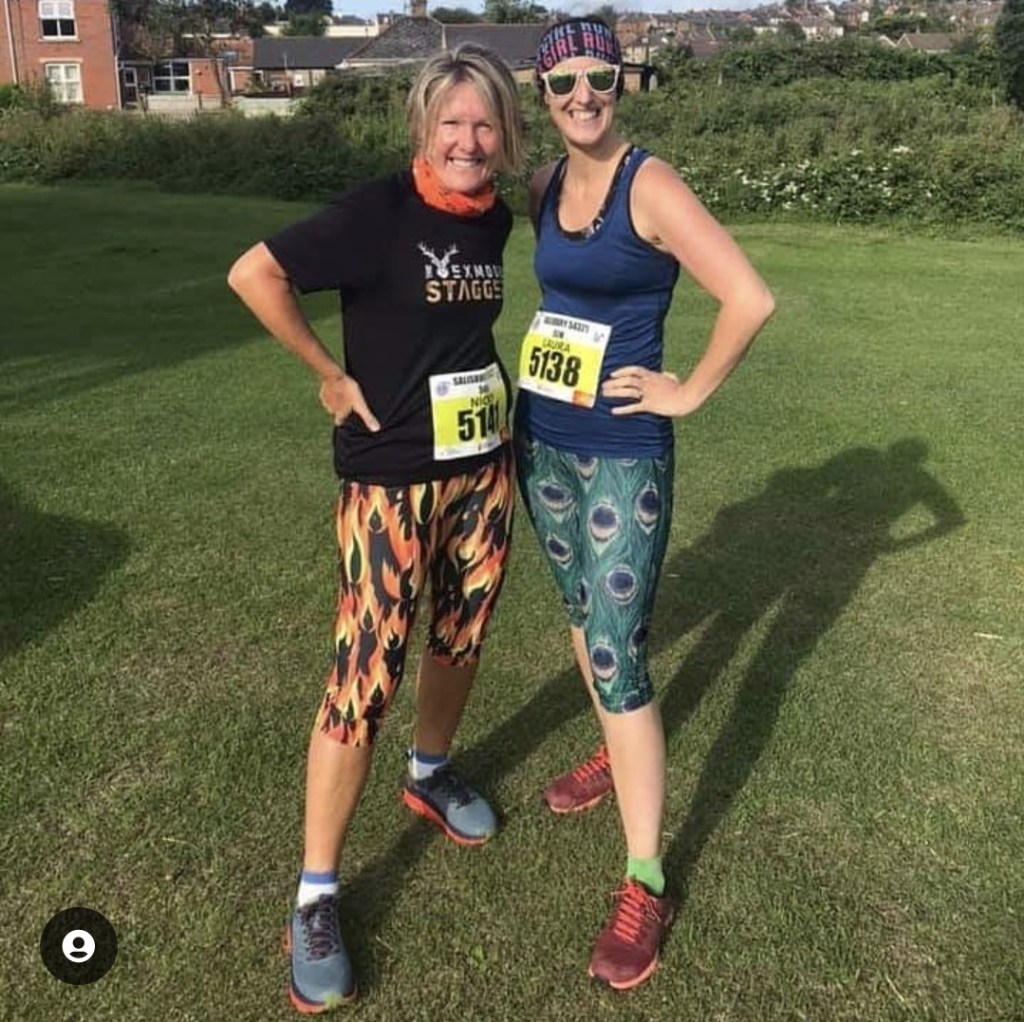
Couldn’t not mention a woman who encouraged my running and who although you’d call an “ordinary” runner, is actually completely extraordinary. Nicky (pictured above) has run more than 100 marathons, she’s run ultras across the world including the Marathon des Sables, and the Atacama Desert. She packed in her job working for a pharmaceutical company to set up her company Flanci when most would be thinking about retirement, as she didn’t think there was enough colour in the running world, and she literally held my hand on my first ultra – the Salisbury 54321. I owe a lot to Nikki in terms of where I am now with my running. She is an inspiration and she’s one of the kindest people I know. That’s the thing about runners. They’re lovely people. Nikki documents her adventures on her Instagram page @nickylovestorunfar

Solo mumming and a pinch of demotivation

Some weeks it just doesn’t go to plan, even with the best will in the world.

Many of you will be able to relate to the struggle of balancing busy lives with some form of training programme (in my case, training is very fluid!)

These past few weeks I’ve been on child taxi duty for most of it, while my husband works away. The cold nights have left me completely disinterested in even heading out to the shed for a dreadmill session, and it’s a mix of the post-January-February-hangover, and simply just not having the time to get out for a meaningful session.

The run4emily turnout was strong

Day to day I’m trying to fit in my work hours, get the children where they need to be, and keep them and the dogs alive and happy.

It’s made me feel RUBBISH. As much as I say it doesn’t matter if I miss a couple of days, missing a week of any decent training runs has an impact on me and my internal monologue.

Whereby I’m usually very much of the “you can do it” mindset, I’ve been starting to tell myself “you’re losing it”.

Who am I comparing myself to? The other Dragon’s in Training on Strava, super quick 5km runners, mostly men. You can see why I’ve been getting inside my own head.

Yesterday I literally had to drag each leg out of bed to run a route I usually relish. Three miles in and I was hating every step. I changed tactic for the second half, I put some music on – something I rarely do as I like to be present in the moment. God did it help! I was bouncing up the hills, motivation was slowly creeping back. Then, home for a shower, a quick turn around to drive to Warminster and Run4Emily

We get there in the end!

A great turn out, but my heavy legs only had chance for one three mile loop before I had to get home.

Yesterday was a slow run day, but necessary day for getting my head back to where it needs to be. It’ll be more short sessions – intervals, treadmills, hill reps mixed in now. The long runs are great, but my goodness they take time and we are all short on that!

This Dragon in Training is still very much in the game!

Reasons to run

When running for others brings hope

I had a phone call last week. It was from the fundraising coordinator for Macmillan Cancer Support.

“Hi, is that Laura? I just wanted to let you know that you were one of our biggest fundraisers last year.”

She’d called to let me know that I’d raised, with Gift Aid, just over £8,100 for the charity, and that the money could fund more than 200 hours of nursing, or pay for 19 grants for people living with cancer.

“I just wanted to say thank you, it’s amazing what you did,” she added.

My response was possibly a little more enthusiastic than I’d planned. I was delighted that I’d had the call and that I’d been responsible for helping this charity as much as I could. I think I said it really was the least I could do.

You may or may not have heard me harping on about running The Macmillan Way (!) – the goal was to raise as much money for Macmillan Cancer Support, with my mate Mo in mind. She’s currently still undergoing treatment for cancer, and has nothing but praise for the organisation that continues to support them.

I’d run it for her – and the distance really felt inconsequential when you consider what she and her family have gone through.

What I hadn’t made public is that just before I set off of my journey, my dear school friend Emily died of breast cancer, earlier that July.

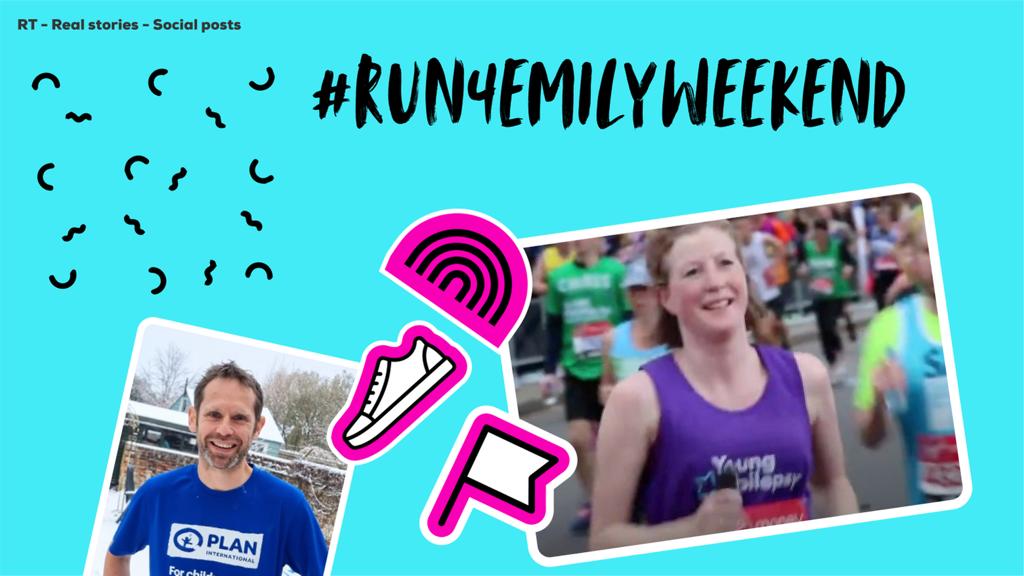
Emily running the London Marathon for Young Epilepsy. Now her husband plans to run for her.

When I felt hopeless, when I hurt, when I wondered what the hell I was doing, I thought of Emily, and I thought of Mo, and I thought of countless other people who fight battles every day of their lives, and I was reminded over and over again, that in spite of the pain and discomfort, I am so lucky to be able to do this.

Saturday, March 4, would have been Em’s 41st birthday – she was just six month’s younger than me. She left behind a husband and two tiny girls who miss her every day.

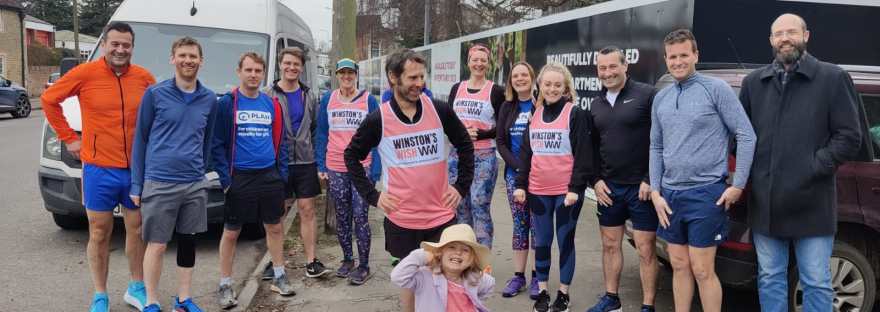
Liam, her husband vowed to run this year’s London Marathon and to honour her birthday, he’s organised this fantastic initiative, Run4Emily

The idea is that anyone can run over Em’s birthday weekend, as far or as little as they wish, to help raise funds for Winston’s Wish, and Plan International, the charities that have supported Liam and the girls.

I’m going to join with Liam and others in Warminster on Saturday, and it would be great for anyone else who wants to, to run some miles too. Liam would love for 30 countries to get involved – he’s close to that target.

You can share your pictures and show your support for Liam by tagging Run4Emily in any runs you do over the weekend, and please visit the website and share the fundraising link at to help spread the word.

So although I run for me. There are times when it’s wonderful to able to run for others too. Not everyone can run, so I’ll run for those who can’t.

Join in a virtual run in support of Liam as he remembers Em and raises money for two important charities

When training becomes part of life

It’s not just a hobby anymore – training has to be a lifestyle choice

Looking out over the Elan Valley, part of the Montane Dragon's Back Race
Remind yourself why you’re doing the training

As the dial on the treadmill sped up to 8 miles an hour and the sweat dripped from my brow, I wondered what exactly it was that drove me to get on the damn thing at 9.30pm in the first place.

Parents and anyone who works, and certainly parents who work, will know that fitting in any kind of exercise class, running session, bike ride, or light stretch, need to choose times that can be utterly inconvenient.

Where a 5K Saturday Parkrun generally fits in with most family’s “free” time – training for a 237-mile multi-day event becomes more of a challenge.

So how can it be done?

For me, changing my mindset of doing exercise as a hobby was key. Exercise couldn’t be just that anymore, it had to be part of my lifestyle. I’d never choose a hobby that involved a 5.30am alarm, or intervals on a treadmill (when is this ever fun?)

Training now is something I need to make happen to ensure events I want to take part in are infinitely more do-able and therefore enjoyable.

I have an idea each week of what I need to achieve. That might be hitting a certain number of miles run, or metres of elevation, or hours of strength training; and then I must plot it in around life. 

I’m supremely lucky in that I can go out for my weekend long run and have a support network that allows that. But when it’s me at the helm, or work commitments have to be met, then the dreaded treadmill, aka DREADMILL, at 9.30pm has to be the way the training gets done. 

No, it’s not always a barrel of laughs, but it’s aiming for an end goal; seeing the bigger picture in the depths of winter when crawling from a comfy bed is literally the last thing you want to do. 

If I want to have the best time traversing the Welsh mountains, or running 50-mile ultra-marathons, or even making it past day 1 of The Dragon’s Back Race, then the leg work has to be done. And therefore, I have to do whatever it takes – after the kids are asleep, or before they’re awake; a snatched lunchbreak; whatever.

As for hobbies – there’s little time left for them!

Sunset over the Dorset Hills
It might mean a sunrise or a sunset run

There are a few tricks I use to drag myself out of bed or run late when I want to go to sleep. Certain mind games I use include:

  • If I haven’t run by the time it’s dark, I tell myself I can either do it then, or it’s a really early start. That way my brain generally convinces myself to get out there.
  • It’s an old classic, but I just get my sports kit on. Just the fact I’m ready to train makes it easier for me to do it. I’ll do the school run looking like a right gym prat, but it tends to work!
  • Use a reward system to convince yourself to work out. On a Sunday, I can tell myself if I run early then they’ll be a roast dinner as a big reward.
  • Take the time to do things with your children and family before or after you train. That way – if you suffer from guilt, then you can reconcile with yourself as you’ve given them your time and attention.
  • Have a visual reminder as to why you’re doing the training. My Dragon’s Back Race map is never far away, so I can remind myself of the work I need to put in.
  • Don’t beat yourself up when life really does get in the way. Rest days are important too, and actually might give you more motivation for getting out there the next day.

Taking the Dragon by the horns

Learning that anything is within your grasp on Day 4 of Dragon’s Back Race with RAW Adventures

Teamwork makes the dream work

A week before I ran in the Elan Valley with a bunch of fellow Dragons in Training, I’d managed to convince myself that perhaps this was all a bit above my station. I’m not a professional fell runner, in fact the joke about me coming from the Somerset Levels now seemed deadly serious. How the hell would I match up to these people who spend their days in the mountains, whose back garden is the Welsh hills, who actually RACE these things?

As a back-of-packer, with a backpack the size of a small country, it was easy to get in my own head and start to wonder what I was doing here. Casing out the competition in Ty Morgan’s cafe in the centre of Rhayader on the Saturday, I was reassured by the swift onslaught of friendly banter, a free buff courtesy of the incredible Kate of RAW Adventures (more on her later), and the advice to buy a coffee and relax while we figured out transport to the start the day’s adventure.

The purpose of my three-and-a-bit hour drive to a small Welsh town? To test out a section of Day 4 of the Montane Dragon’s Back Race. Already this seemed overly optimistic. What if I don’t even make it to Day 4?

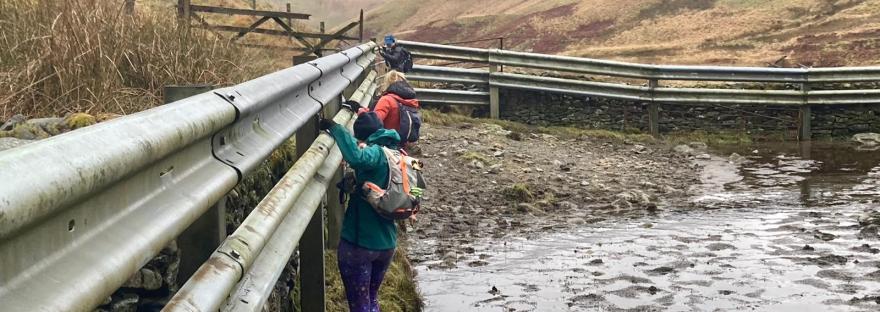
Crossing the bog of eternal stench

We began our huddle about six miles south of the start of of the day’s route. Taking out our previous year’s maps from the race, I looked around at the five other participants. A few clearly knew their stuff when it came to map-reading and navigation skills, but I was comforted to see a few confused looks, upside down maps and waving of agitated compasses. We were all here to learn.

The description from the map reads; “remote and rarely visited hills and forests are the hallmark of this day, as are the famous grass tussocks of the Elan Valley hills. The route goes to one of the highest summits in Mid Wales – Drygarn Fawr – on the remote moorland plateau of the Cambrian Mountains. Keep each other in good company on this day, as you are unlikely to see anyone else!”

This section of the DBR is a kind of squishy, mossy, spongey, marshland, without the spiky sharp bits that you expect from days 1 and 2 of the race. One of my comrades described it nicely as “The Bermuda Triangle of the race”.

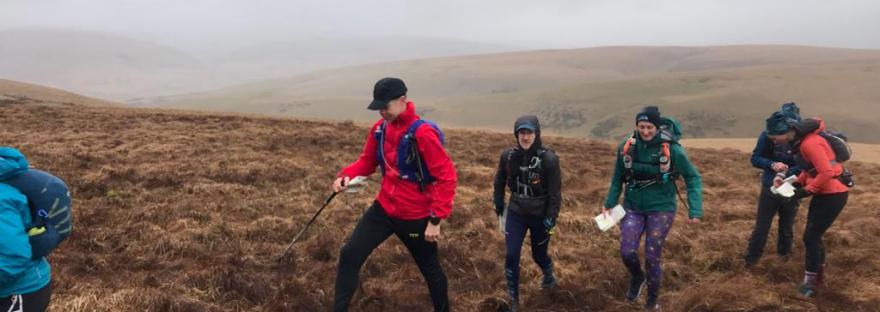
He wasn’t far off. As we set off over tussocks and divots, aiming for the first checkpoint known as ‘Fence Corner’ (yes, the clue is in the name), the landscape became nondescript, the mist fell, it felt bleak. I imagined being lost out here, frantic, alone. But bit by bit, guided by Kate and thanks to the generous knowledge-sharing of my teammates, things began to make sense.

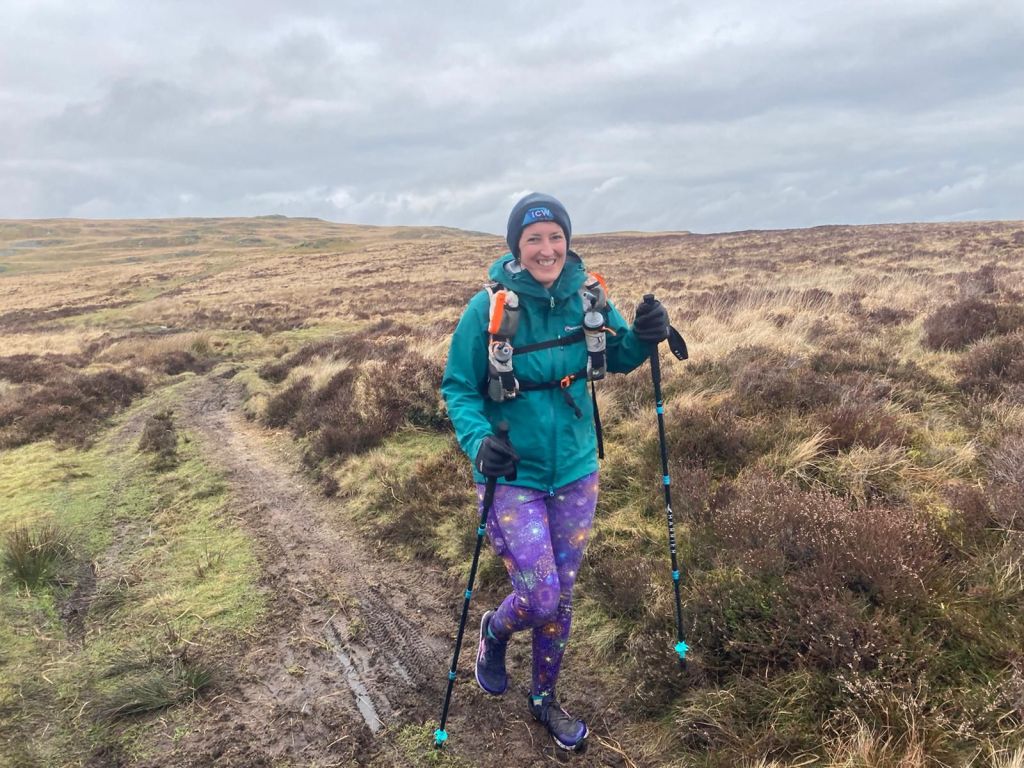
Getting to grips with new poles

Look for that triangle, that might be a trig point. Check out the next physical landmark, don’t rely on the permissible path markings. Check the ground for trods.

I knew that I wouldn’t be the strongest runner. Some of the others were like mountain goats, striding with purpose and generally ahead of the pack. But we regrouped often, and we rotated. Some points I wasn’t even at the back! I was trialling new poles, and new shoes, so there was a lot for me to take on board. I fell once, due to a pole user malfunction, and as my banana went flying ahead of me, a teammate stopped to check on my wellbeing. Thankful for the wet bog I’d landed on (fondly renamed the Bog of Eternal Stench), I arose victorious and unscathed.

Over 14 miles we laughed, listened, learnt, and got to grips with both the enormity of what lies ahead of us, but also of the ultimate possibility.

We’re all so good at doubting ourselves. I was doing it before I even set out, but hearing these other fabulous athletes voicing their own anxieties about the race I realised that we all just pick different bits to agonise over. One told me she’s never done a multi-day event like this one, but had still managed to knock out a 50-hour race; another was concerned on the downhills because of dodgy knees; we all worried we’d get lost, miss a cut-off time, lose a checkpoint.

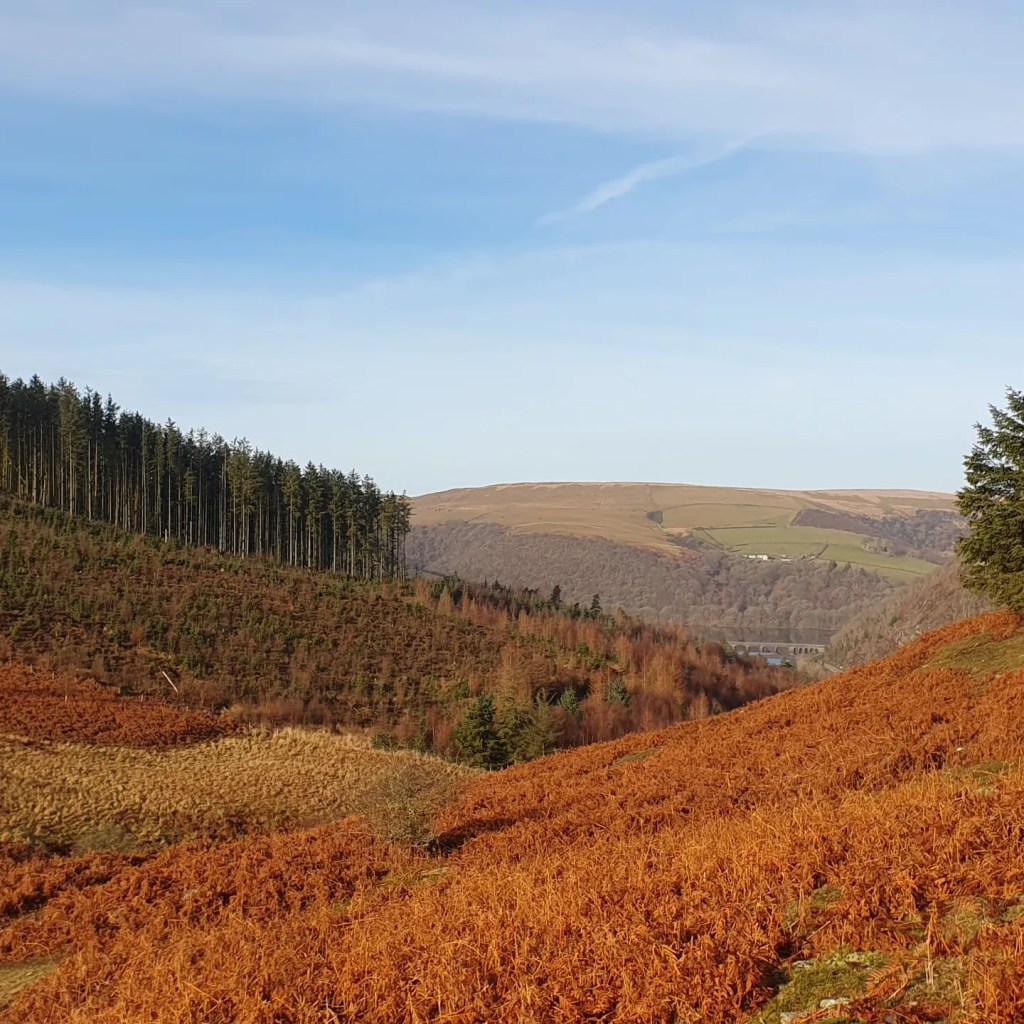
Just the best views across the Elan Valleys

All these worries are human nature. I had the absolute luxury of running a stretch of road with Kate, our esteemed leader for the event. We talked about strategies and goals, and that by knowing now I need to work on my hill-running legs, then I already have a measurable goal. She said she doesn’t go out and do more than 13 miles at a time just yet; that everyone comes from a different place and that we all have to work on different elements. Some are physical, some are mental. We’re still seven months out and there’s time.

One thing Kate said really stuck. When we finished, beaming from ear to ear because it had genuinely been the most fun and enjoyable day, she said: “not one of you seemed out of your depth.”

It’s what I needed to hear. I was part of this too.

Aren’t we brilliant at limiting ourselves. I think everyday life pushes us back into those boxes that tell us that’s as much as we can do, that a mountain is too high, a run too long, that our bodies can’t take it. Unlearning that takes time and practice.

The next day, I got up early, grabbed the map and continued the journey by myself. Twelve more glorious miles, in the crisp mountain air.

  • Inspired to run the Dragon’s Back Race? Enter here
  • Want to meet Kate and know you can do anything? Check out RAW Adventures

Packing for a day in the mountains

The weather forecast was reading “feels like -1” and I’ve been fooled by mountains before.

A ‘run’ up Scafell Pike for my 40th birthday gave me at least a flavour of how weather conditions can turn on a sixpence.

That day we’d stopped short of summiting, mainly due to the fact that I was wearing a thin yellow jacket not at all suitable for the weather (some of you might remember fondly my “banana coat”, an inadequate pair of gloves and I knew the weather would be worse the further up we went.

That’s a lot of kit!

This time around I’m facing the hills of the Elan Valley with the Raw Adventures team, as part of a day 4 Dragon’s Back Race recce. Asked to pack as if it were race week, we have to think winter, and be prepared so not to let anyone down.

So what exactly does winter mountain packing involve?

The mandatory kit list for the Dragon’s Back Race is extensive. When you sign up to a race like this, you mustn’t forget that essentially you’re on your own up there. If you haven’t packed it – you can’t get to it. You need to be ready for sudden changes in temperature, a drop in visibility and you need to be able to stay safe, and warm.

The hills of the Elan Valley

This weekend we’ve been advised to take:

A waterproof jacket: Hardshell/taped seams and a good hood.  Mine’s a Montane Element Stretch jacket, which has a 10,000mm hydrostatic head – a fancy way of saying it’s really waterproof!

Waterproof trousers: Hardshell/taped seams. I’m taking two pairs with me so I can see on the day if it’s going to be torrential rain or if I need a slightly lighter pair that are a bit easier to run in.

Survival Bag: Bag, not blanket. Most of you will have seen those big silver space blankets, but in the hills it’s better to have a bag as it will insulate you better. Mine comes from a really cool Trail Runner starter kit from Harrier.

Map. In this case a Dragon’s Back Race 2022 map, which I can reference while we navigate the route.

Compass. Well, you know, navigating with a map does require a compass! A “thumb” compass is great as it’s light – for this outing I’ve got a compass with a cover though.

Headtorch. And spare batteries or spare head torch: I went and purchased the quite frankly insanely good Petzl NAO-RL while at the running show. It’s so good. And a spare Petzl for good measure, too.

Whistle: This is to alert anyone if you’re in distress. Mine is built into my Raidlight pack.

Food and Drink: Snacks/food sufficient for the day and at least 1-1.5 litres water (aim for 300 calories per hour). We all know I’m down with the food and drink. I take Active Root sports drink, plus a selection of dried fruit, nuts, bars, and sandwiches.

Synthetic Insulated Jacket (spare). I have a Buffalo jacket which has saved me on many an occasion. If you keep moving it keeps you toastie warm. It’s not waterproof, however

Additional Mid-Layer: Fleece or windproof jacket/layer. I’m taking a selection of warm garments.

Hat and Gloves. As it’s winter, I’ll have two pairs of gloves, and a pair of over gloves, and ALL the hats!

Trail/Fell Shoes. Here’s where my barefoot Vibram Fivefingers may have to take a back seat for the rocky spiky sections and be ready for the road/soft sections. I’ll be adding to my bag a pair of Altra Lone Peak Trail Shoes.

Personal First Aid Kit. You can pick these up in most chemists, or in the Harrier kit I mentioned earlier.

Money. Cash/Card for car parks. I mean, it’s self explanatory really!

Mobile Phone. For those mountain top selfies. In a waterproof bag if you want a working phone when you get off the peaks!

GPS Watch/Unit. My Garmin Fenix 5 has stood me in good stead thus far, so that’s what coming along with me.

This is a basic list and you’ll get to know what works for you the more you go out there, but it’s important to really check off the safety elements of your kit. If you’re underprepared, then prepare to be pulled off the mountain, or to have a pretty rough time of it when you’re up there!

Next week I’ll tell you all about my adventures in the Elan Valley.

The problem with stretching: best complementary sports for runners

Show me a runner who stretches religiously and I’ll show you ten who don’t. And me.

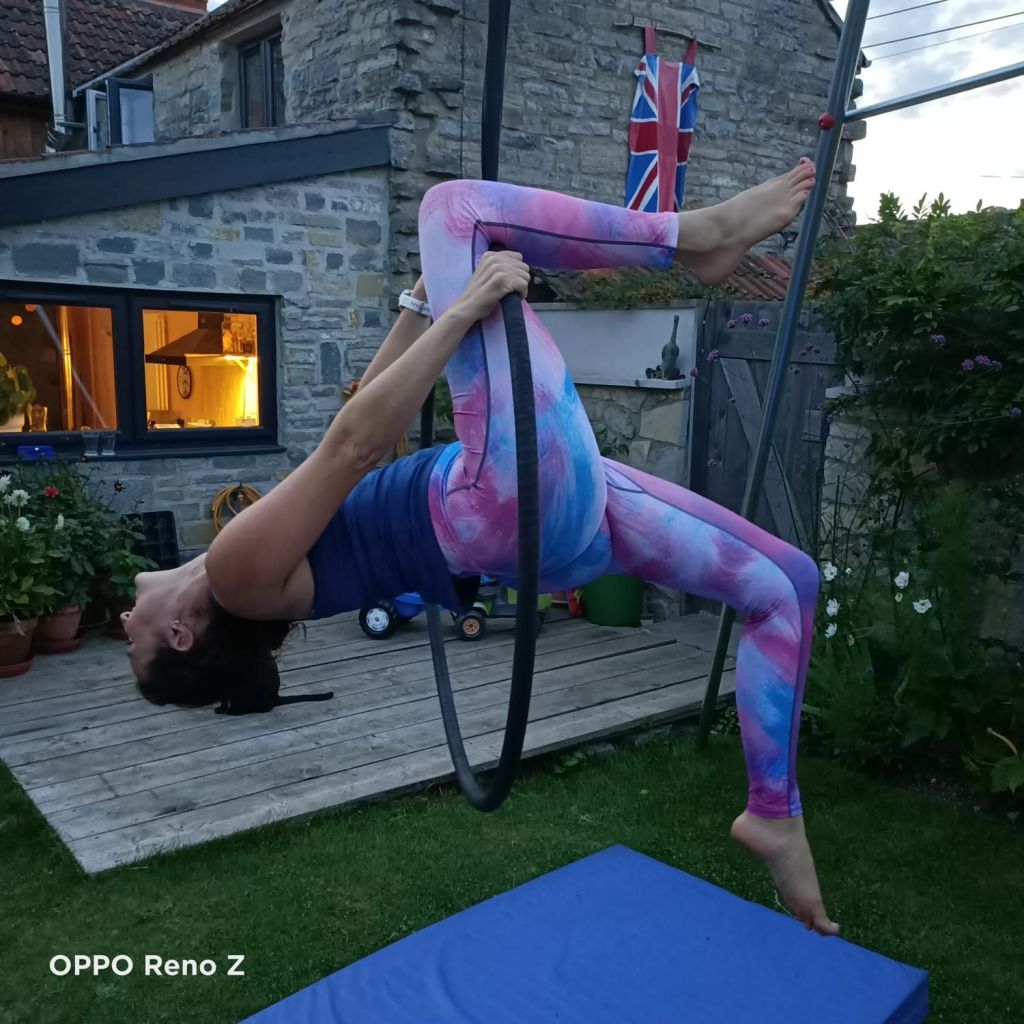
My personal trainer (I go once a week for a HIIT session) used to mock my hamstring stretch as being pitiful at best. It was only after taking up the obvious complementary sport for runners; arial hoop, that the hamstrings finally started to return to what are now deemed “normal” stretchy levels.

Laura attempts aerial hoop which is a great complementary sport for runners.

As brilliant as flinging around on a hoop is for my flexibility; I can’t say my aerial hoop skills are complemented in any way by my running. Each week I turn up with stiff limbs from a run the previous day, and if I’ve forgotten to keep up any kind of stretching for the rest of the week, it takes a good half hour to get anywhere near a straight leg while suspended from the ceiling.

But hoop FORCES me to stretch. You can’t hold on for dear life for a full hour; you have to actually engage your core and stretch your legs as far as is possible in order not to fall off for a good number of moves. It all helps this middle-aged runner and I’ll take anything I can get to help me in the stretchy stakes.

Back to the running though: it’s been improved thanks to more mobility in my hips, a stronger core, and just being fitter all round. I was never the gymnastic one at school, and I don’t foresee myself joining the circus anytime soon, but for me, aerial hoop is a brilliant sideline to running and one that I’d encourage anyone to have a go at.

There are, however, more conventional sports that pair really well with running. Here are a few, in no particular order.

  • YOGA

I’m going to come right out and say it “yoga is great for runners” and wait for all those runners to recoil. But SERIOUSLY, it’s great for you. It helps with balance, posture and of course, the all essential stretching.

  • ROWING

Say what?! Yep, rowing – it’s so good for strength. That core is getting a severe workout and you have to really work on your posture to get the best technique.

  • CYCLING

Runners do give their joints a right pounding. That’s not necessarily a bad thing all the time, but it does make a lot of sense to take the pressure off the joints while maintaining great cardio fitness. Cycling ticks that box well and truly.

  • SWIMMING

Another joint-friendly choice. Swimming lets you take the pressure off your body a bit, but you still get the conditioning and all over fitness that complements running so well.

  • BARRE CLASS

I’ve never tried this. Come to think of it, I haven’t rowed much either. But Barre is meant to be a really great thing to do if you’re a runner – or anybody really. It takes its principles from dance, and focuses on posture and alignment; something that comes in very handy when you run.

All the above don’t necessarily mean you’re going to be stretching more, but you should be. Trust me. I still don’t do it enough, and when I don’t I really know about it!