I’d factored the Hope 24 Trail Running Festival into my training. It offered hills, time on feet, and sleeplessness. All things that I’ll need to be able to deal with on the Dragon’s Back Race.
It all seems so easy in the first few laps!
Off I headed to Newnham Park near Plymouth to meet up with my team and to join the camp which included a bunch of friendly faces from the club I used to run with, The Langport Runners.
We were vague on strategy. The concept was a five mile loop, a baton, and only one member of the team allowed on the course at any time, over 24-hours.
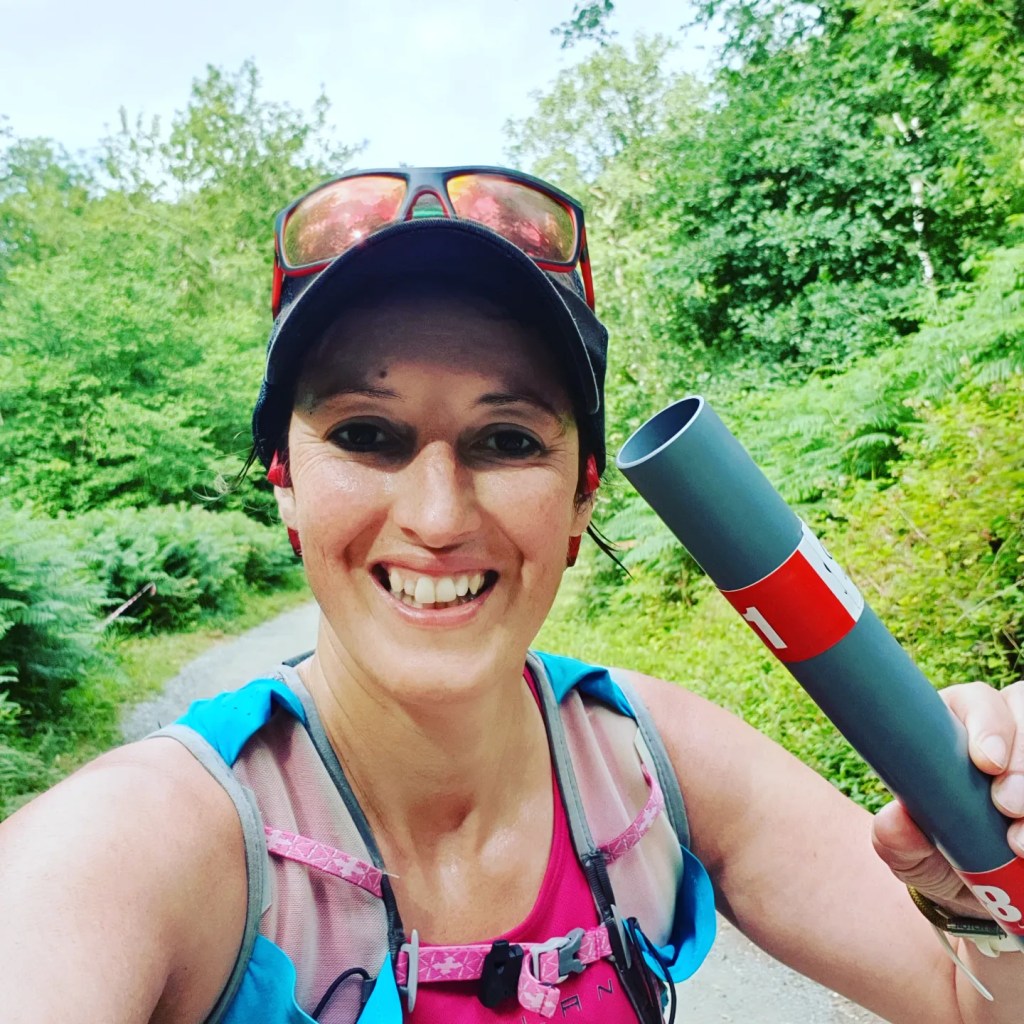
The baton firmly in my clutches
We made it up on the hoof. We would all run one lap, two or three times, then do a double when it got dark to give the others a chance for some sleep, and then finish off with whatever we had left.
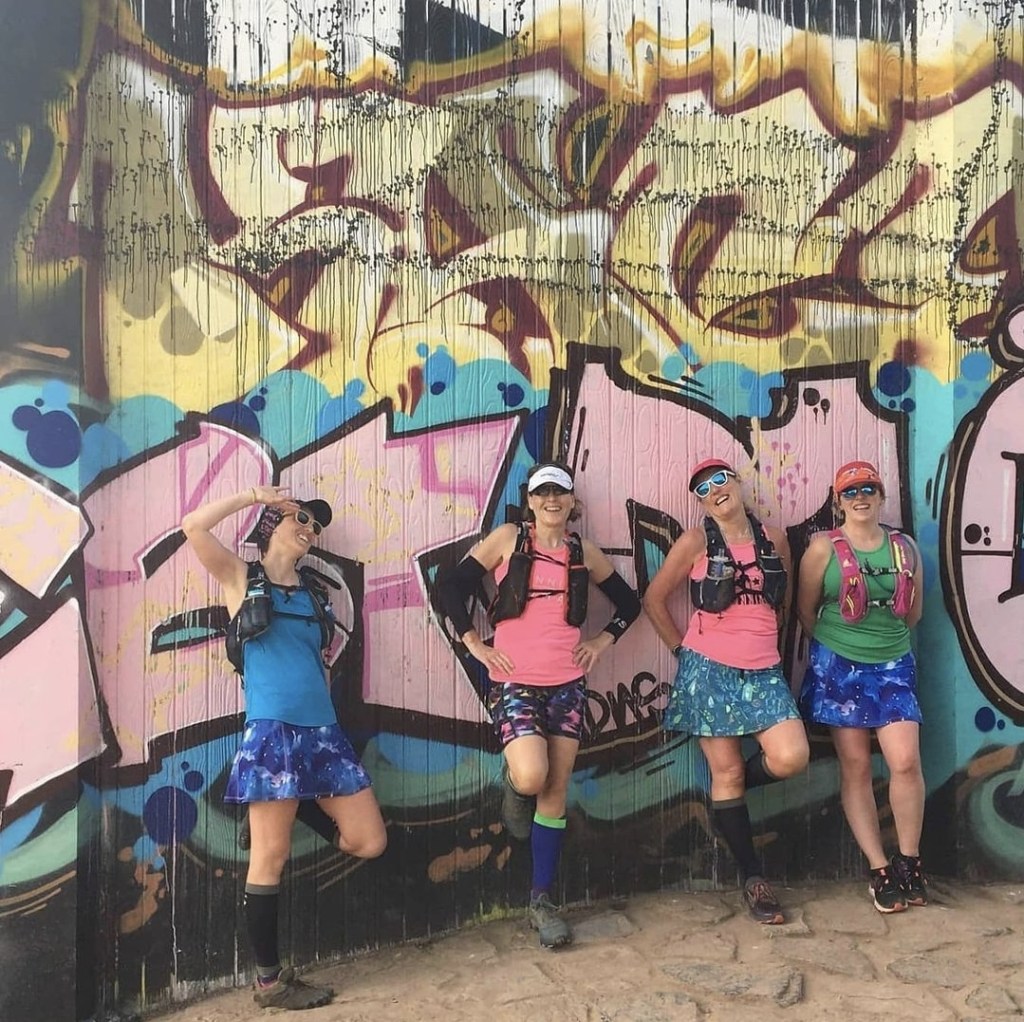
What worked so beautifully is that as a team of four ladies, all over the age of 40, we were evenly matched and we can all run sub one-hour loops. We just kept going.
The course was beautiful. I’d say undulating, but probably most would say hilly. After the sixth lap there were parts that I was less than pleased to see again.
As I took on my first five miles of the double, at half past midnight, it became clear at mile four that I’d “misplaced” the baton. You know, the crucial thing with the timing chip in it, that would be the make or break of us getting a time at all. It had jumped out of my pack at some stage of the loop, and was nowhere to be seen.
My stomach dropped. What the hell would I tell my teammates, who were currently snoozing away, none the wiser? After deliberating and slowing considerably, I made the call to carry on and hope that the Race Director would understand my plight.
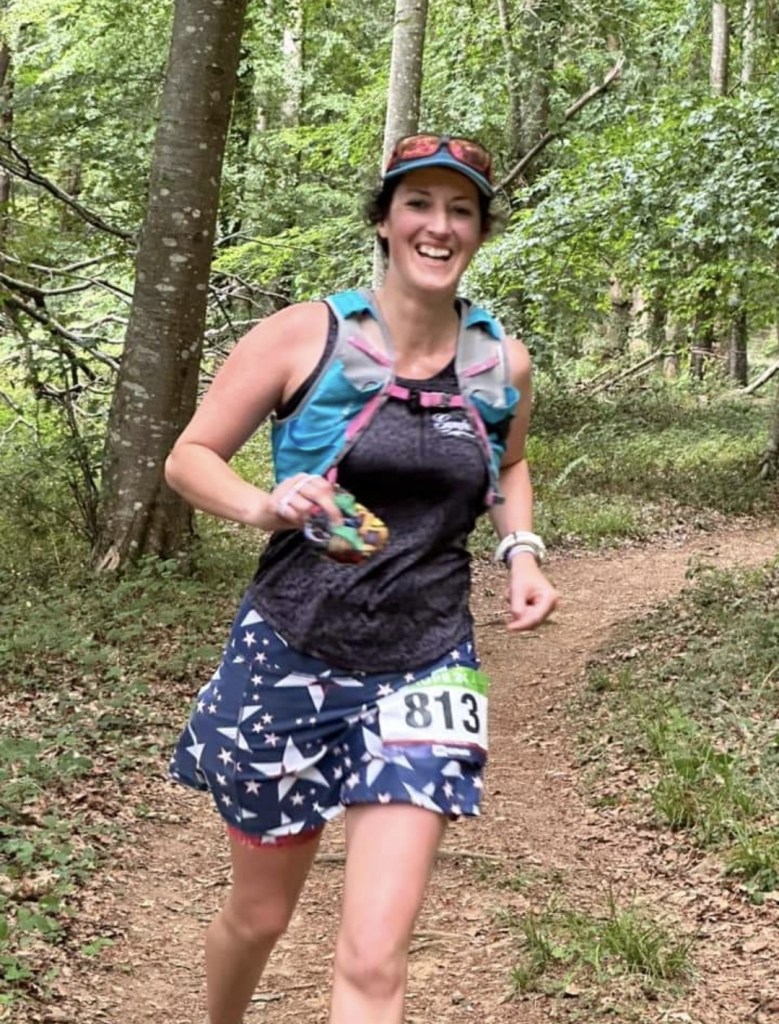
The look of someone who has lost the baton, somewhere, in the middle of the night
Luckily, he was sympathetic and took a note of the time, photographed my number, and asked me to find the baton on my next loop round!
And just like that, it appeared in the first mile, like a beacon!
Crisis over and approximately one-a-half hours of sleep later, I completed a total of seven laps – 35 miles, and my teammates ran a similar race. We managed to have someone running at all times throughout the day and night, so 24 loops later we were all tired but happy, and went off to collect our giant-face-sized medals and can of Erdinger.
Imagine then our surprise, when on top of all this we were hailed as the first all-women team! We’d come with no expectations and finished on a real high.
Winner winner , vegan dinner!!
Well done to the Vegan Runners as they were strong in numbers and performance on this event, also to the lovely Vicki Trundle, who I’d met at the Hilly 50 and recommended Active Root to. She racked up 30 incredible loops, 150 miles, over 36 hours, which quite frankly blows my mind!
It started with a nightmare. The evening before Operation Crib Goch (OCG), my tired quads were already twitching, but the nightmare was intense. Apparently I was mumbling and screaming in my sleep. Perhaps I’d built this up in my head far more than I realised.
For someone who will take on most things, Crib Goch had manifested into some kind of death-monster in my brain.
Naturally, on the morning of OCG – it was hard not to be excited. The sun was shining fiercely; I’d tackled Tryfan and the Glyders on the previous day to bolster my confidence, and it felt like that monster I’d conjured up might be quietening.
Friendly faces gathered at the Nant Paris Park and Ride, the Place To Be for mountain junkies, Duke of Edinburgh participants, Scouts, people carrying poles, ropes, and wearing grippy shoes.
Four Mountain Leaders for this RAW Adventures expedition – these people are like superheroes – human form, but with mountain goat/ballet dancer/fell runner qualities. You can feel safe with them.
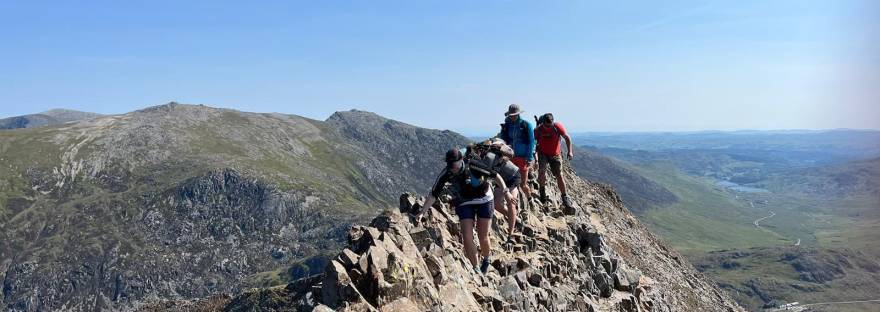
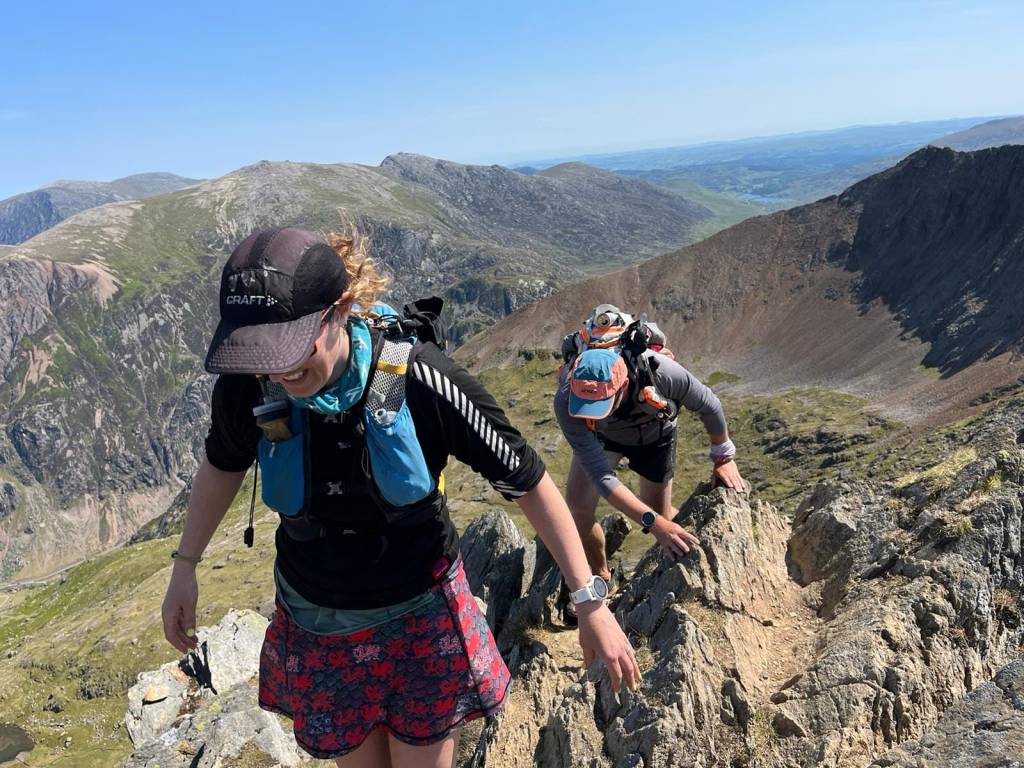
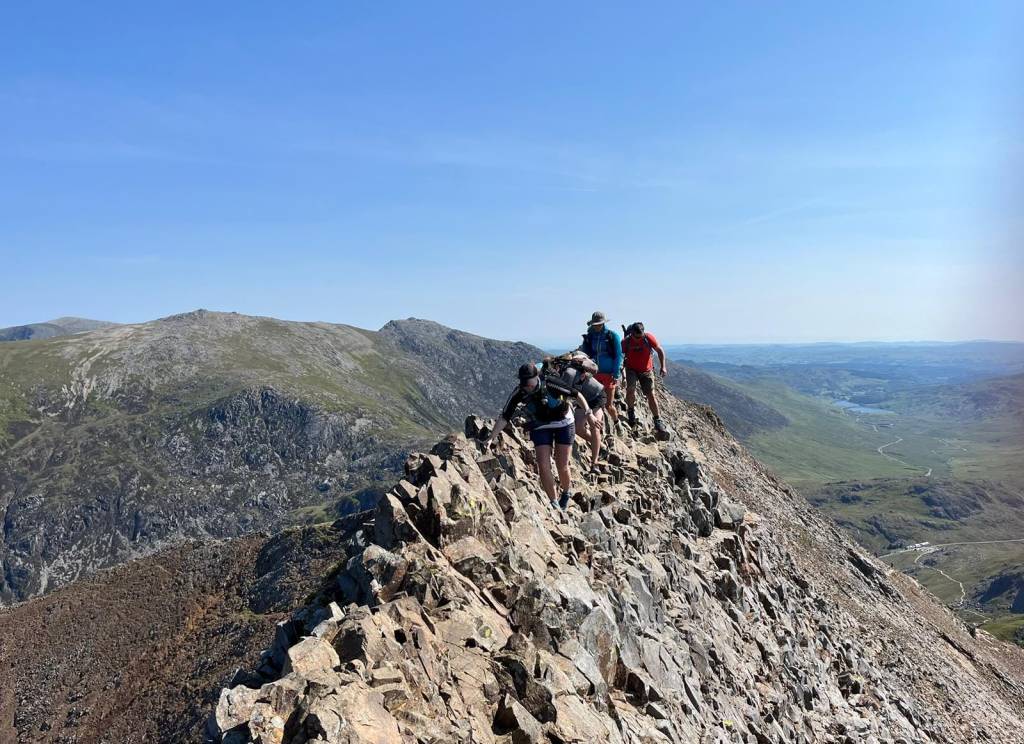
And so, we began. From Pen Y Pass, toward the looming beast. We were taught the mantra “Crest is Best”, and our guides pointed out the line we needed to take.
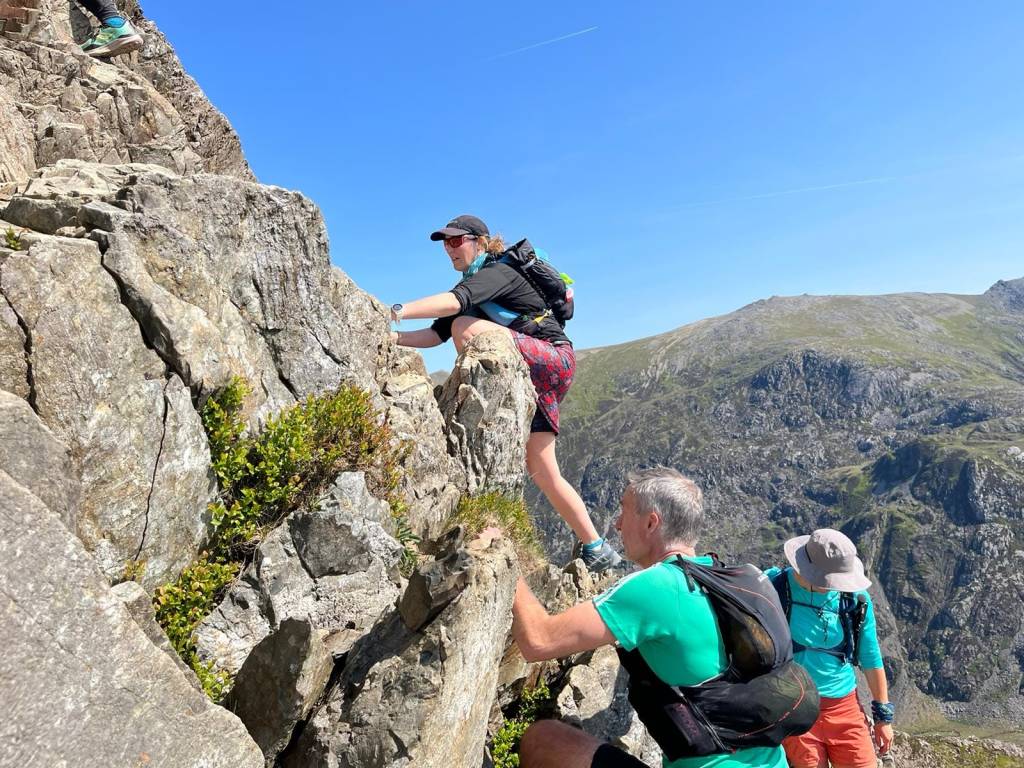
There’s a school of thought that suggests if you don’t overthink it, don’t look down, don’t hang around too long, that it’ll be over before you know it. Well anyway, that was my school of thought. I like big rocks. There are hand holds, and I feel safe holding on. I have the strength to haul myself up, and I’d rather face big rocks than the dusty scree you can easily slip on – there was plenty of that later.
Up we went. Helen, one of the superheroes, reminded us to keep our nose, hips and feet in line. “Make sure you can see your feet” – that way we’d be more stable. The urge to hug the rock was great – but this was not the suggested approach.
Approaching the infamous ridge to Crib Goch, the Red Ridge, John, another of the superheroes looked at me, “Laura, try and remember to breathe.” Oh, what sage advice! Things are much easier if you continue to breathe, and I’d genuinely forgotten to do so.
Now I was breathing again, watching my feet, finding my hand holds and getting my groove. The ridge suddenly felt very do-able. Remember we had glorious sunshine. There was little wind, and if I did it again in higher winds, then yes – I’d be more nervous.
Ten minutes to traverse the ridge.
That was all.
Ten minutes. Ten intense, brain aching, gripping on for dear life minutes, but still – only ten minutes.
Next, more technical terrain. On to Snowdon, to complete the horseshoe. We got the poles out. Turns out I need to get a damn sight quicker going downhill (and there was I thinking I liked down!)
It’s fear, trepidation. It holds you back, tells you you’ll turn an ankle, fall, die. But when you can breathe, and gain some balance, tell yourself to just go with the mountain, you can move quicker. This is what I need to work on.
OCG wasn’t to be taken lightly. I’d never take it lightly. You need to plan, check the weather, have a good level of fitness and know what you’re doing, but it’s achievable and the rewards are massive. What a feeling. Kind of like you’re superhuman…..
And as for that monster – right now, he’s having a sleep.
Other things to note about the day:
Kate, super hero number 1 bagged up a human poo and removed it from the rocks of Crib Goch. Normal humans, please don’t poo on mountains. And if you do, take it away.
We picked off two empty Stella cans from the ridge. John peeled off a sticker. There was garish bright pink graffiti on one of the trig points. Again – not ok.
There was a queue of people waiting to have their photos taken on Snowdon summit. They could have just gone straight up to it from a different angle. The Brits do love a queue, don’t they.
It was hot. At mile 9.5 – unknown to me we were nearly back at the bus, but I was withering. That’s down to a lack of water. Always take more water.
I also need to give a special mention to superhero Jade, whose hat with its wide brim became a focal point for me in times when I felt myself falling back. That hat – was epic.
When you push your body and mind to its limits, it can feel euphoric when you cross the finish line. You can also just feel exhausted!
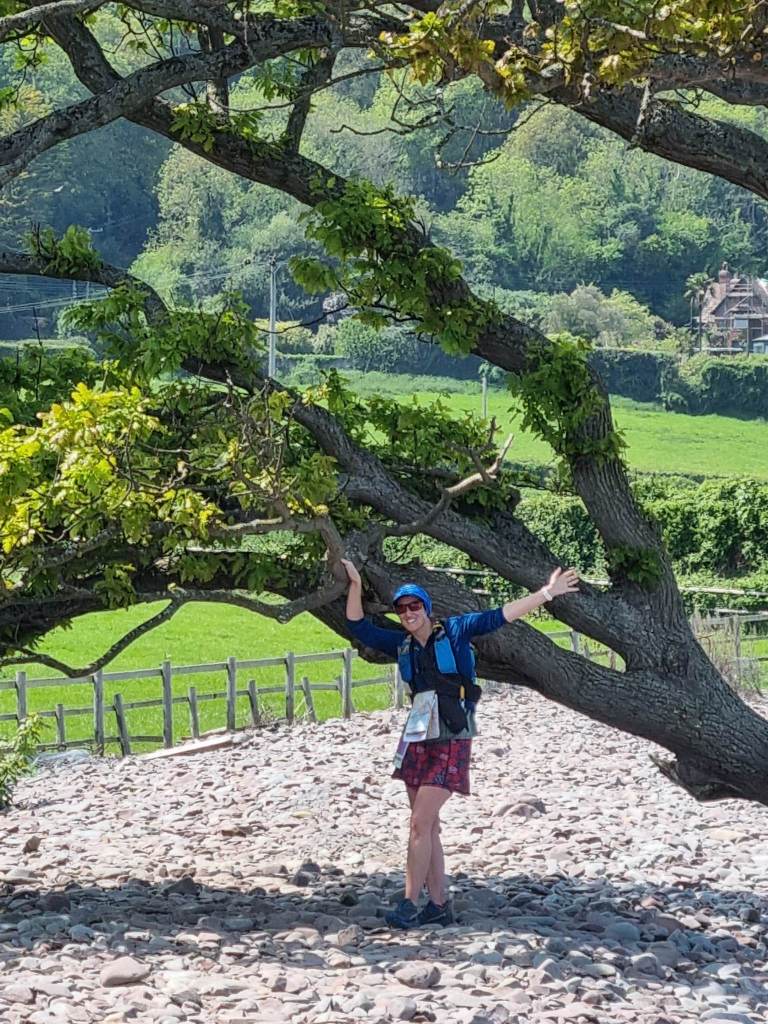
A really nice tree that we ran past
I’m always humbled when it’s Marathon time of year – you know, all those inspiring people who’ve won a place at the start of London Marathon to raise money for charity and spread awareness for good causes, those who earned themself a holy grail ticket to run Boston Marathon because they’re just phenomenal runners, and all the others in between. With the rise of the ultra, it’s easy to forget just how far and tough a “normal” marathon really is.
A very beautiful and pebbly beach
I first ran one in 2009. It was then the Flora London Marathon. I was in my early 20s, before I was married with kids. I’d done the absolute minimal training, I certainly wasn’t a regular runner, and I hate road running. No surprise really that it took me 5 hours 35 minutes, and I felt very underwhelmed at the finish line.
That was well before I got any kind of real love for running. My trail adventure running came much, much later. As for road marathons – that was it for me. I’ve not done one since.
Now though, I understand the need for training. That you can’t just throw a pair of shoes on and hope to get a good time, or even to feel good at the finish. While a marathon is tough, really tough. How exactly does someone then go and run 50 miles?
I’ll try and explain. I’m a back of packer, but I know that all I need to do is throw one foot in front of the other. I can be quicker, that comes with very specific training, but at the point in my training for the Dragon’s Back right now, I know I just need to up the miles and the elevation. Really, the elevation is the killer here.
Training has been consistent but not quite where I’ve wanted it to be, given time constraints of family life and juggling work, dogs (not literally juggling them – they’re far too heavy), and children. I was ill in April too which threw me totally and messed up my plans for any quality running.
So when the Albion Hilly 50-mile ultra marathon popped its head up, I figured, I need to do this.
I know what you’re thinking. Not much training again. Why would you do that?
Here’s why. Because I’m going to have to do something tougher come September and putting myself outside of the comfort zone was necessary. For my confidence; to get the miles in my legs; and to just get some serious elevation – away from the flats I’m used to. This route would take us from Minehead up all the hilliest hills Somerset could throw at us – Bossington Hill, over to Porlock Weir, Webber’s Post, to Dunkery Beacon and back again.
This was a bit of a make or break moment. Could I actually cover the distance over 8,300ft?
I hooked up with a fellow runner, who was trepidatious about it too. We made a vow that we’d get each other round. Having that kind of pact makes it harder to quit.
For the first three miles we went off too fast. Ten minute miling maybe. That’s because there were runners up ahead who would break the course record – it’s easy to get swept along in that kind of frenzy. My runner partner and I however, are not those people! I pulled right back. I know my body and it takes me about five miles before I’ve got into any kind of stride. The uphills were walked, the downs and the flats run. We took photos in the sunshine. For 25 or 30 miles it was glorious.
Eating frequently and taking on fluids is vital. The weather was hot, and you can easily forget to fuel if you don’t feel like it. It’s a matter of forcing it down. With such wonderful checkpoint volunteers, they advised that one stretch would be an 11-mile uphill slog before the next aid station, and that we should eat as many Marmite sandwiches and pickles as we could before attempting it. I took their advice. I frequently ate.
Although this was a partly way marked course, you had to have your wits about you and navigation was key. We took a couple of wrong turns. Trying to ascend to the summit of Dunkery Beacon (highest point in Somerset), while having chosen the incorrect path, saw my mood dip and I snapped at my compadre – I was getting tired and we were going the wrong way.
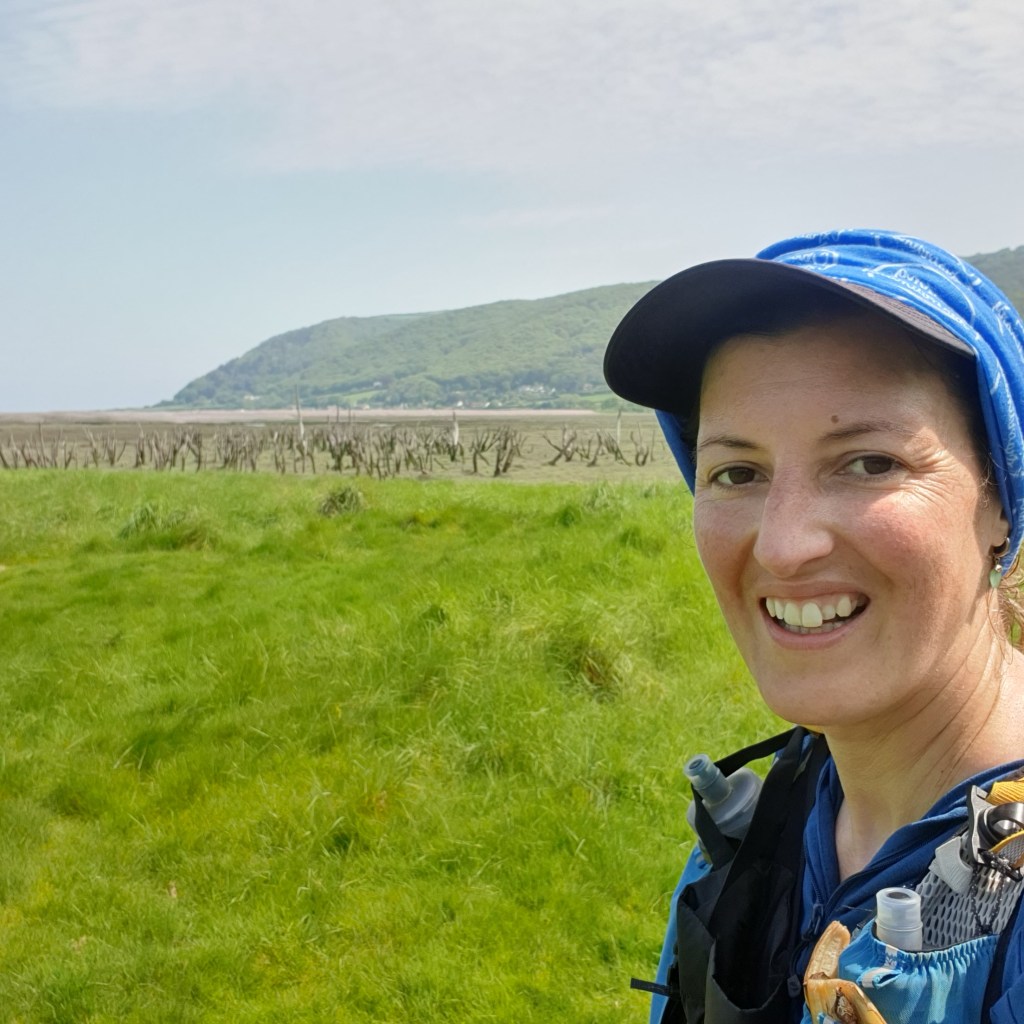
Still feeling pretty fresh here!
After we righted ourselves and hit the top of the Beacon in dazzling sunlight, we sailed through the next few miles. The sun dipped and our next challenge was getting through the woods before nightfall. We made it, but with darkness comes new challenges.
It was hard to see underfoot. Bumps look flat, and hills look hillier, sheer drops you can’t see at all! I fell once, but luckily it was a soft landing. A good head torch gives you confidence in the dark.
I’d anticipated some niggles in my legs, and especially my feet, because I was trying out the shoes I’ll wear on the Dragon’s Back Race. The niggles never came. This told me that although I didn’t feel I had trained enough, what I was doing was paying off. If anything, it was my back and shoulders that were starting to stiffen. Wearing a pack and leaning into hills will do that.
The final eight miles were both a mental uplift and a total physical slog. By this point I felt nauseous at every sip of drink – Active Root sports drink – or every nibble of food. The pace was slow. My partner’s knee was starting to hurt. Nevertheless, by this stage, you know you’ve done it.
We powered on. We fast hiked the final mile, and finished feeling – erm, quite good actually. Euphoric? Maybe not. Knackered? Most certainly – it was 2.30am, after all!
Huge thanks to Albion Running for such a gorgeous event. The volunteers were fabulous and the food selection was dreamy for a vegan!
Albion also offers a Flat 50, and the 100 (if you fancy doing both hilly and flat!), as well as other fab races, which you can find on their website.
Learning when to stop has been an important lesson for me as I strive to slay the Dragon
You know the person that always says hi, is permanently perky, doesn’t shut up giving positive affirmations and constantly tries to cheer other people up? Well that’s me. Mostly.
Being an eternal optimist has always stood me in good stead. I don’t stress about much, I “grab life by the balls”, and all that stuff. But recently, a swathe of pessimism and bad luck started to chip away at that perky exterior.
Training has certainly suffered as a result of a lack of time, but more worryingly, due to a lack of enthusiasm. It’s been totally out of character. The cherry on top of the Cake of Gloom was a proper belter of a head cold/virus, that struck before the weekend recce that would see me attempt 17 miles from Conwy Castle (start of the Dragon’s Back Race), to the Ogwen Valley support point.
As a merry band of Dragons gathered at the meeting point, I knew that although I wasn’t feeling my best – a lack of sleep, a total shocker of a journey up the night before, and a trepidation that I think everyone experiences before these events, I would nonetheless give it my best.
Early on, as the other Dragons skipped their way up the hills – I knew I was far from skipping – more trudging. Reluctantly, begrudgingly. My legs didn’t want to cooperate and my head – well it felt like it might just explode.
I didn’t want to talk. When the lovely team members asked questions and started chattering, I was one-line answers at best. What the hell was going on? One guy even ran back to check in on me. “I’ve been there”, he said. “It chips away at you mentally.” Boy, was he right. Being back of the pack when you’re working at capacity can feel like a grenade to the brain.
RAW Adventures Event leader Kate knew something was up. She’d seen me running in February and knew that things were amiss. Where was the perky Laura she’d met two months ago? She asked gently, maybe we should think about splitting the group?
I didn’t need much convincing. The pace I was running meant at least another seven hours on the mountain. I didn’t want to hold the others back, and I certainly didn’t want to feel like this for another seven hours.
Save your legs, Kate said, Make the next day count.
We turned back at seven miles – after summitting Tal y Fan, and took a gentler slope back down into Conwy. I’d managed 12 slow miles.
I’d cried. I doubted if this was even achievable. This race is not for the feint hearted. Here I was failing on a recce – what the hell chance did I have on race week?
But here’s the thing. We don’t win all the time. In fact every step of the journey is beset by stumbling blocks – mentally and physically. Sure, I could have run the 17 miles but in doing so, what would the rest of that week’s training look like?
At least my legs were fresh enough to summit Pen Yr Ole Wen the following day – just shy of 1,000 metres. By myself, in the mist.
This is a lesson. A powerful one. That no, sometimes Laura you can’t just steamroller through something and hope you’ll wing it with a smile. That a cold, a virus, a blow to your immune system, really will take it out of you, and you can’t just brush that off.
That it’s OKAY to take a few days to eat, drink, rest, recuperate, and come back to a stronger mindset and feel like you can see a way through.
I couldn’t write this blog post for a while. What was the point, I thought? It’s not even like I can run well at the moment. Who even wants to read this? But I think it’s important that I document the low parts, because everyone deserves to know that failure is crucial. It’s the getting back up that makes us stronger…… and see, even the positive mantras are starting to come back to me again!
By the way. Kate, you’re amazing. I think everyone needs a Kate in their lives.
Off the back International Women’s Day I feel it’s important to celebrate women and the great stuff they do all year round.
I mean, I’m a mum all the time, so where Mother’s Day is just a tokenism – I hope that I’m appreciated the rest of the time too! International Women’s Day is a brilliant concept, but let’s not forget women for the rest of the year.
I’ve been thinking about women in sport, and in particular, trail and ultra running. Training for the Dragon’s Back Race and working it around mum life, day to day work and taxi-ing, I’m thinking about the barriers that affect my journey getting to the start line, and I’ve been talking to other women and finding out what their challenges are. There’s a bigger piece in the pipeline about women’s barriers to ultra running, but for now I wanted to focus on those runners that I hold in high regard for speaking out, making change, holding true to their beliefs and leading to positive changes in the sport.
There is no particular order to this list, and there are so, so many more than this, but here are some women that have made me sit up and think, and feel more empowered to continue with what I believe too. I hope they can inspire you too.
Sophie Power
A photograph of Sophie breastfeeding her three-month old during a 106-mile ultra went viral – it’s now featured in the Guardian’s 50 Photographs that Reshaped Sport, and off the back of the photograph she used the publicity to launch the SheRaces Campaign, fighting for equal opportunities in racing, and working with event organisers to make their events more inclusive.
Pregnancy deferral policies and race guidelines that consider female participation have all been taken up by various events thanks to Sophie’s work. Not only is her breastfeeding image iconic, she’s also a phenomenal runner.
I interviewed Sabrina for a piece about trail running vs road running, and her passion for trail running was just so contagious (despite me loving it already!) Sabrina is a co-founder of Black Trail Runners, and as a mum of four, and having faced so many challenges before finally tying up her shoelaces and setting up an all-female running group, she’s a mental health advocate and an inspiration for women runners from all backgrounds.
Fiona is an elite ultra runner and the fastest woman in the world to run a marathon on all seven continents and the north pole in both cumulative and elapsed time. Not only that, she’s had 17 surgeries on her right knee which saw her kneecap being completely removed, she runs a sanctuary which looks after more than 600 animals, she’s competed in more than 100 marathons, placing top twenty in Berlin and London marathons and she’s a vegan! What a flipping amazing human being!
Vic (above) is one of three women on this list who I’ve had the pleasure of meeting in person – I first met Vic, aka The Happy Runner, when she and I were involved in The National Running Show Indoor Relay. It blew my mind that someone could run around and around her back garden completely barefoot for marathon miles, and then she went on to became the fastest person and only woman to run The Monarch’s Way. She inspired me to try barefoot running, but more than that I think she actually showed me that it’s ok to run the way you choose and not be constrained by societal norms. She’s a wonderful human and now runs We Run Bright, a running clothing brand together with her friend and fellow runner Gavin King.
Follow Vic on Instagram at @thehappyrunnernw
Nikki Love
Nikki is an advocate for anyone who wants to do it their way. An author, speaker and runner, Nikki’s tagline is “Chasing Extraordinary”. Adventure is in Nikki’s bones, and as a runner in her 50s, she smashes stereotypes, shows that running is possible for everybody and speaks out about running through menopause. Next step – Nikki’s only running across Australia, beginning on May 1, that’s 63 consecutive marathons, a total of 2450 miles and you can follow her journey and read about it over on her RunAustralia page or on her social media @nikkiloveruns
Nicky Chrascina
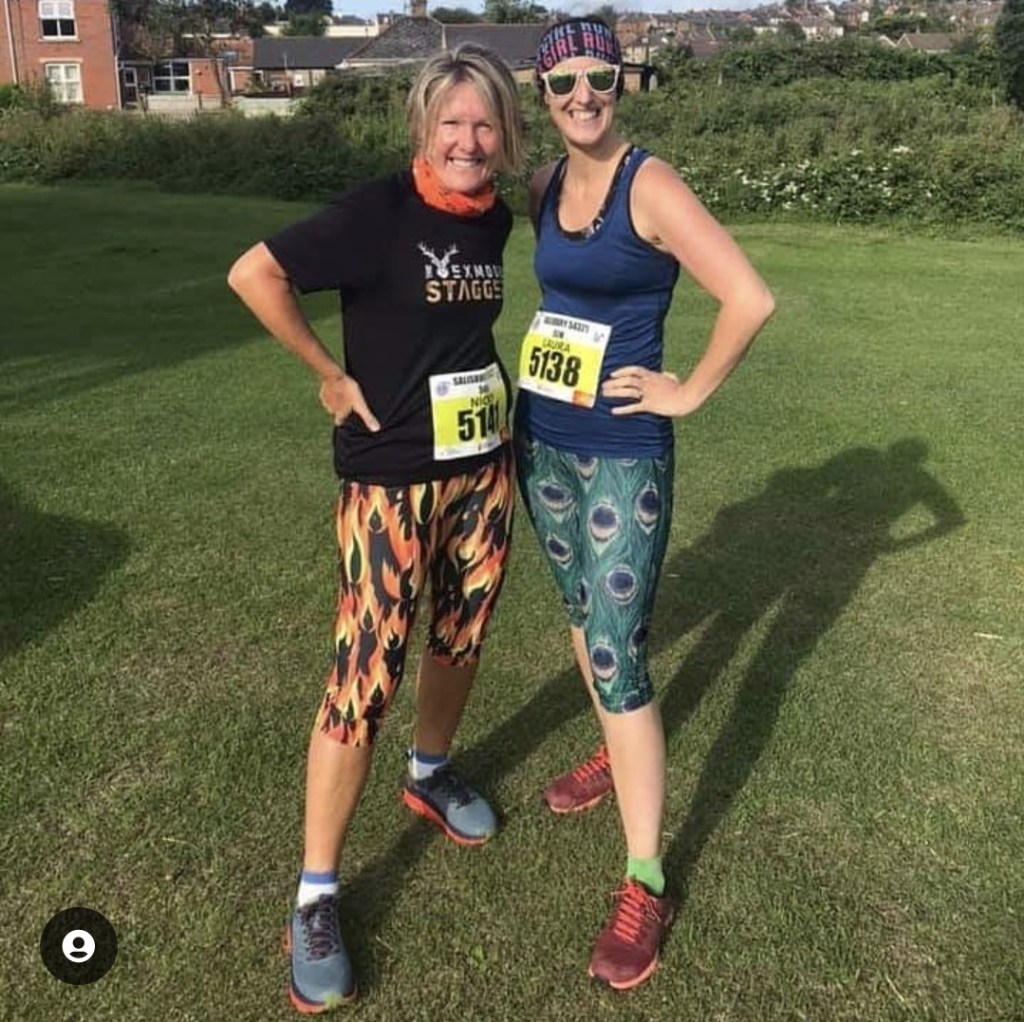
Couldn’t not mention a woman who encouraged my running and who although you’d call an “ordinary” runner, is actually completely extraordinary. Nicky (pictured above) has run more than 100 marathons, she’s run ultras across the world including the Marathon des Sables, and the Atacama Desert. She packed in her job working for a pharmaceutical company to set up her company Flanci when most would be thinking about retirement, as she didn’t think there was enough colour in the running world, and she literally held my hand on my first ultra – the Salisbury 54321. I owe a lot to Nikki in terms of where I am now with my running. She is an inspiration and she’s one of the kindest people I know. That’s the thing about runners. They’re lovely people. Nikki documents her adventures on her Instagram page @nickylovestorunfar
Some weeks it just doesn’t go to plan, even with the best will in the world.
Many of you will be able to relate to the struggle of balancing busy lives with some form of training programme (in my case, training is very fluid!)
These past few weeks I’ve been on child taxi duty for most of it, while my husband works away. The cold nights have left me completely disinterested in even heading out to the shed for a dreadmill session, and it’s a mix of the post-January-February-hangover, and simply just not having the time to get out for a meaningful session.
The run4emily turnout was strong
Day to day I’m trying to fit in my work hours, get the children where they need to be, and keep them and the dogs alive and happy.
It’s made me feel RUBBISH. As much as I say it doesn’t matter if I miss a couple of days, missing a week of any decent training runs has an impact on me and my internal monologue.
Whereby I’m usually very much of the “you can do it” mindset, I’ve been starting to tell myself “you’re losing it”.
Who am I comparing myself to? The other Dragon’s in Training on Strava, super quick 5km runners, mostly men. You can see why I’ve been getting inside my own head.
Yesterday I literally had to drag each leg out of bed to run a route I usually relish. Three miles in and I was hating every step. I changed tactic for the second half, I put some music on – something I rarely do as I like to be present in the moment. God did it help! I was bouncing up the hills, motivation was slowly creeping back. Then, home for a shower, a quick turn around to drive to Warminster and Run4Emily
We get there in the end!
A great turn out, but my heavy legs only had chance for one three mile loop before I had to get home.
Yesterday was a slow run day, but necessary day for getting my head back to where it needs to be. It’ll be more short sessions – intervals, treadmills, hill reps mixed in now. The long runs are great, but my goodness they take time and we are all short on that!
This Dragon in Training is still very much in the game!
It’s not just a hobby anymore – training has to be a lifestyle choice
Remind yourself why you’re doing the training
As the dial on the treadmill sped up to 8 miles an hour and the sweat dripped from my brow, I wondered what exactly it was that drove me to get on the damn thing at 9.30pm in the first place.
Parents and anyone who works, and certainly parents who work, will know that fitting in any kind of exercise class, running session, bike ride, or light stretch, need to choose times that can be utterly inconvenient.
Where a 5K Saturday Parkrun generally fits in with most family’s “free” time – training for a 237-mile multi-day event becomes more of a challenge.
So how can it be done?
For me, changing my mindset of doing exercise as a hobby was key. Exercise couldn’t be just that anymore, it had to be part of my lifestyle. I’d never choose a hobby that involved a 5.30am alarm, or intervals on a treadmill (when is this ever fun?)
Training now is something I need to make happen to ensure events I want to take part in are infinitely more do-able and therefore enjoyable.
I have an idea each week of what I need to achieve. That might be hitting a certain number of miles run, or metres of elevation, or hours of strength training; and then I must plot it in around life.
I’m supremely lucky in that I can go out for my weekend long run and have a support network that allows that. But when it’s me at the helm, or work commitments have to be met, then the dreaded treadmill, aka DREADMILL, at 9.30pm has to be the way the training gets done.
No, it’s not always a barrel of laughs, but it’s aiming for an end goal; seeing the bigger picture in the depths of winter when crawling from a comfy bed is literally the last thing you want to do.
If I want to have the best time traversing the Welsh mountains, or running 50-mile ultra-marathons, or even making it past day 1 of The Dragon’s Back Race, then the leg work has to be done. And therefore, I have to do whatever it takes – after the kids are asleep, or before they’re awake; a snatched lunchbreak; whatever.
As for hobbies – there’s little time left for them!
It might mean a sunrise or a sunset run
There are a few tricks I use to drag myself out of bed or run late when I want to go to sleep. Certain mind games I use include:
If I haven’t run by the time it’s dark, I tell myself I can either do it then, or it’s a really early start. That way my brain generally convinces myself to get out there.
It’s an old classic, but I just get my sports kit on. Just the fact I’m ready to train makes it easier for me to do it. I’ll do the school run looking like a right gym prat, but it tends to work!
Use a reward system to convince yourself to work out. On a Sunday, I can tell myself if I run early then they’ll be a roast dinner as a big reward.
Take the time to do things with your children and family before or after you train. That way – if you suffer from guilt, then you can reconcile with yourself as you’ve given them your time and attention.
Have a visual reminder as to why you’re doing the training. My Dragon’s Back Race map is never far away, so I can remind myself of the work I need to put in.
Don’t beat yourself up when life really does get in the way. Rest days are important too, and actually might give you more motivation for getting out there the next day.
I’ve got into the groove this week with a more positive mindset and efforts to do some meaningful training. I’m telling myself over again that this is my race, and my race only. Mild panic set in previously from reading other comments from incredible fell runners who make mountain running look easy, and I wondered if I was in way over my head even attempting the Montane Dragon’s Back Race this year.
I’ve sat down with a Mountain Leader/navigation guru, and we’ve made plans for a Brecon Beacons recce. I’ve got two weekends in the diary for recce events with Raw Adventures that cover sections of the Dragon’s Back. I’ve starting hill training, strength training, and understanding that I need to run most days again.
One positive move I made was sitting in on a webinar with Shane Ohly (race director), and former participants Kirsten Isak, and Ben Morris. Since watching, I’m breathing a few sighs of relief.
I had this overriding concern that in order to complete DBR I’d need to be a navigation ninja. I’m now reassured that it’s not necessarily the case. A GPX file is given to participants, and there is an event map; but I don’t rest on my laurels – my Brecons training will hopefully hone my skills with a compass and a map, because let’s face it, I don’t want to be reliant on a breadcrumb trail when I’m facing the elements and the Welsh mountains.
Dutch former-DBR participant Kirsten agrees that running with a map and compass is a great idea. Picking a line saves you time and effort.
The second piece of information to really put my mind at ease a little is learning that the marketing images of DBR (the ones where runners are picking along a stretch of spine-like mountain with a seemingly deathly drop) along the technical bit known as Crib Goch, is actually only 300 metres long. Race Director Shane reassured that tens of thousands of tourists go there, you can’t get lost along that bit, and most people don’t die!
The really exciting piece of news for me is the details on the food. Breakfast and dinner is provided! Cooked as well – unless you’re after the likes of muesli and cereal. For the record, I’m all about the food. My philosophy is eat like you don’t know where your next meal is coming from!
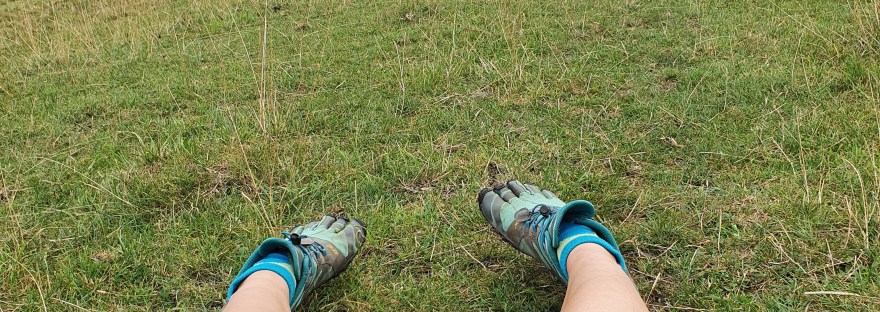
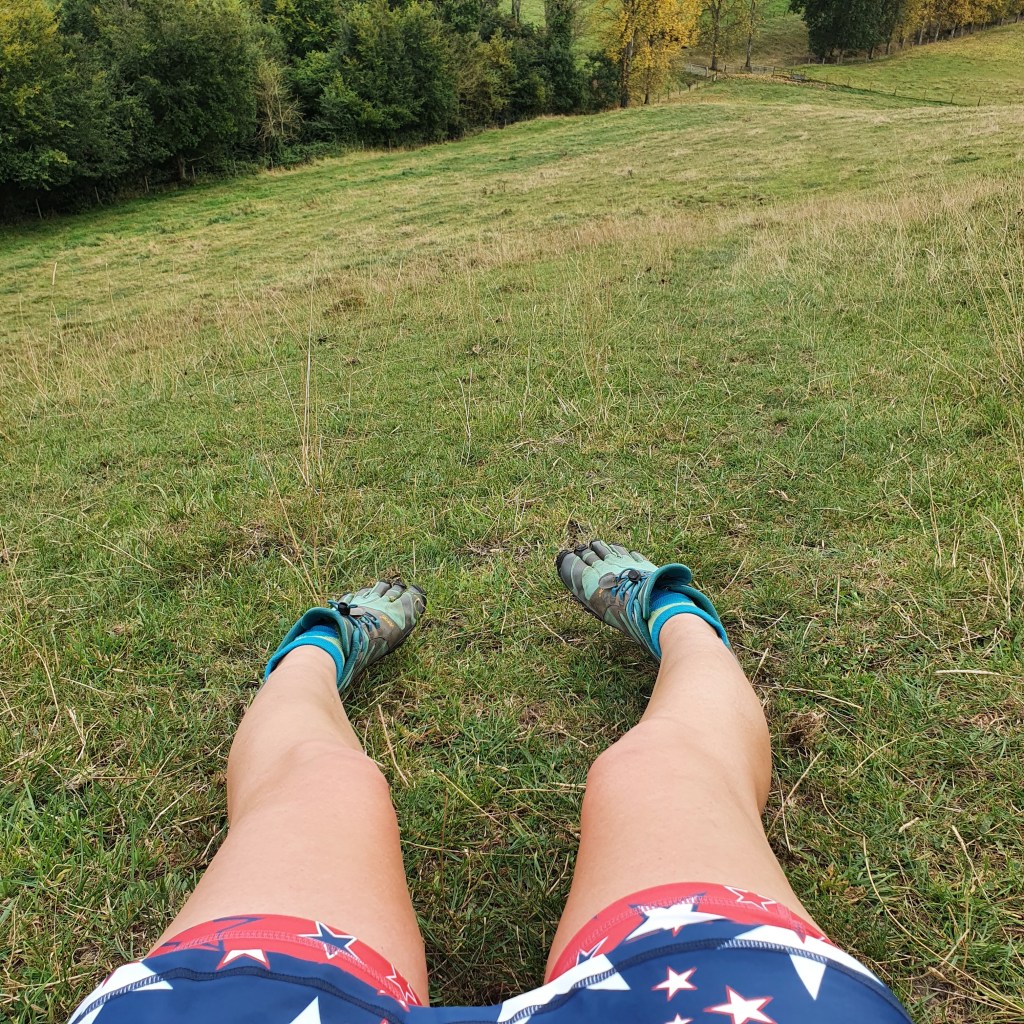
My sticking point currently is which footwear I need. My diehard barefoot friends say that my Vibram Fivefingers should be allowed, and would recommend I stick with those, however Eleanor Clarinbold of Dragon’s Back Race recommends something more robust, given the extreme terrain. I’m going to have to do lots of testing and getting out there to find out what I feel most confident in. Both Ben Morris and Kirsten Footwear say footwear is massively important – the biggest thing to get right. They suggest three or four pairs – a camp pair to use for running on road, that’s comfy and roomy, and something tight and grippy for rocky days. A trail shoe, for obvious reasons. But I want to throw barefoot in there too, for times when the terrain isn’t so brutal. After all, it’s what my feet know.
It’s great to hear from a former female participant. Kirsten herself even says it’s a shame more women don’t enter. Part of the reason I’m documenting my journey – to encourage more women to take the plunge and take on the Dragon.
Extra handy Dragon hacks from Shane, Ben and Kirsten:
Give some serious consideration to your sleeping mat (don’t save weight on this!) Get a good one.
Test your kit rigorously beforehand.
Pack two head torches – one for camp that you don’t have to worry about packing for the run
Less kit in camp is better.
Sort your food rations and label them for each day.
Keep it simple. Don’t give yourself to worry about.
Pack the night before so you’re not rushing in the morning.
You can watch the Dragon’s Back webinar with Shane, Kirsten, and Ben, here
Forced to stop running? Struggling with injury, illness, or just a lack of time? Here’s how to cope
(This article is an updated version of one I wrote for Trail Running Magazine back in lockdown)
Illness is abound. Every person I know either has, or has had, the lurgy – this hideous flu, Covid, or they’re just feeling plain run down. January has a strange effect on us, too. A lack of motivation, the post-Christmas blues, the sense that any get up and go has got up and gone.
I’ve been here myself, I had two stints of strict ‘rest’ enforced on me after I broke my foot, twice.
Even weeks before Coronavirus was even in the public consciousness, a stress fracture had put paid to my scheduled races that year, and suddenly the goals that I’d slogged over for the previous year were pulled like a rug from beneath me.
Just a few short weeks later and I was sharing life in isolation with the rest of the world.
Time to Grieve
Chartered Sports Psychologist and author of Performing Under Pressure, Dr. Josephine Perry, was training for Paris Marathon before Covid hit. She says it’s ok to be demoralised if you’re out of action through illness or injury – for a bit.
“We need to acknowledge that we’ve missed out on stuff, the plans we’ve made have changed, and it’s absolutely ok to be really upset. It’s ok to throw your toys out of the pram and sulk about it for a day or two, but then get into proactive mode, and start making a plan.”
Training for the likes of the Bob Graham Round, and Spine race, Dr. Perry’s athletes had no idea how long it would be before they’d pick up training again – and it’s just as hard for recreational trail runners as it is for the elites when they’re grounded.
She says: “What tends to help most runners is having some kind of plan; it’s about setting goals but also being realistic about what’s possible.
“Don’t do anything that’s going to reduce your immunity – we don’t want people doing hours and hours on turbo trainers or going out for really long runs. For someone who is running an ultra every weekend, a two-hour run is very easy for them; it won’t stress their physiology too much. For someone who does Parkrun, an hour run is going to be pushing them a lot more than they’re used to, so it’s about really keeping within yourself.”
Try something that challenges you in other ways, and builds strength where you’re lacking
Getting the Buzz Back
Maintenance – not improvement – is what you can concentrate on when you’re out of the training game.
Focusing on what we’re not so good at, rather than mourning what we can’t achieve can actually give us a real sense of achievement.
“Think about the beginning of your season and work out where you fell down most in terms of weaknesses,” says Dr. Perry.
“Take the next eight weeks, or longer, turning that into a strength.
“When you’re working on something that you have low confidence in, or you’re not very good at, you can improve quite quickly, and when we find ourselves improving our brain releases a chemical called dopamine which is our reward chemical – it gives us a little bit of a buzz every time we improve, so when we’re trapped inside and we can’t do what we normally do it’s a really nice way to make ourselves feel good.”
Eat well
Nutrition plays a huge part in feeling good and staying healthy.
Ben Adkin, personal trainer and vegan nutrition coach at Planted Strength and Fitness, has a few simple steps to maintain condition.
“Stay hydrated,” he says. “Try to drink around 1L of water for every 25kg of body weight. Make sure you eat enough protein – around 1.8 to 2.2 grams per kg of body weight, and if you can, download a calorie tracking app to workout your total daily energy expenditure. “Limit processed or junk foods to a minimum and really strive to get as large a variety of fruits and veggies in your day to day nutrition as possible. “ Prep your food. Know what you’ve got in the house and start the day with a game plan. “These nutrition strategies should keep you as sharp as possible while you’re getting back on track.”
Growing Resilience
There’s nothing we can do about getting ill or injured, but we have to make the best of it. Dr. Perry says: “We have to be resilient because we’ve no choice. Resilience is a really interesting concept. It’s not necessarily something we think we’ve developed, in the midst of it. It’s only on reflection when we look back, that we’re able to see how we grew.
“There’s a whole area of research in psychology around growth through trauma. Some elements of trauma can stretch us, we can grow through them, we can see how strong we actually are.”
Light at the End of the Tunnel
My broken feet mended, in fact, I got stronger overall. I can’t say I won’t break again, but I’ve learnt techniques to get through if I have to take time out.
“People shouldn’t feel like they’re failing,” says Dr. Perry. “It’s important that we’re kind to ourselves. We don’t want anyone to feel like they’ve failed. If they’re deconditioned and they haven’t used the time productively, it’s not the end of the world, but if you have some time on your hands, then why not use it well?”
SURVIVAL HACKS
Julia Pizzichemi owner of Anatomy Matters, has help hundreds of athletes become champions, working on physical and mental resilience.
Here are her hacks for out-of-action trail runners :
Visualisation: Focus on where you feel you need to improve and hone those skills so weaknesses can become strengths.
Build a training plan: Whether your priorities are rehab, prehab, recovery, conditioning, or functional training, a plan is key so you can maximise the time you have and get specific.
Focus on Recovery: Fundamental to keeping your body in better physical condition, having a break from intensive training is good. Excessive training causes physical stress and can be detrimental to performance.
Injury Rehab: If you have an injury, take time to work on stability and strength of joints such as ankles, knees and hips and lower back, then build in endurance.
Stretch: Use stretching to reduce the build-up of tension and adhesions, and allow for an improved range of motion.
Self-improvement: No matter the challenge, if you look hard enough there is always a benefit. Athletes are naturally competitive and have a strong desire to win whether achieving a gold medal or improving on their personal best. It has to start with the mindset.












 Vegan Fitness Runner